


Learning from Purbayan: When Rivers, Fish, and Communities Become Part of the Effort to Build Food Self-Sufficiency
That morning, I stood on the banks of the Purbayan village waterway. In my hand was a bucket of fish feed. As I scattered the feed onto the water's surface, the fish immediately swarmed toward it, competing for the food.
At a glance, the activity seemed very simple. There was no high-end technology, massive infrastructure, or anything that appeared particularly extraordinary.
Yet, from that simple event, an important question arose: is it possible for the potential lying so close to community life to become part of the effort to build food security?
This question is relevant because food security is often imagined as something that must begin with large-scale projects. We talk about vast agricultural tracts, technological modernization, investment, infrastructure development, and various national programs.
All of those are certainly necessary. However, food security is not built solely through mega-projects. Its foundation can also grow from the environment closest to the community: villages, rivers, land, water sources, fish, and the willingness to manage them together.
In Purbayan, the potential of the waterways is utilized to develop the cultivation of various freshwater fish species. These fish are not merely viewed as economic commodities, but also as a source of food and protein that can provide direct benefits to the community.
From this, we can see that food security is fundamentally not just about how much food a country can produce. Food security is also related to a community's ability to identify, manage, and utilize available local resources sustainably.
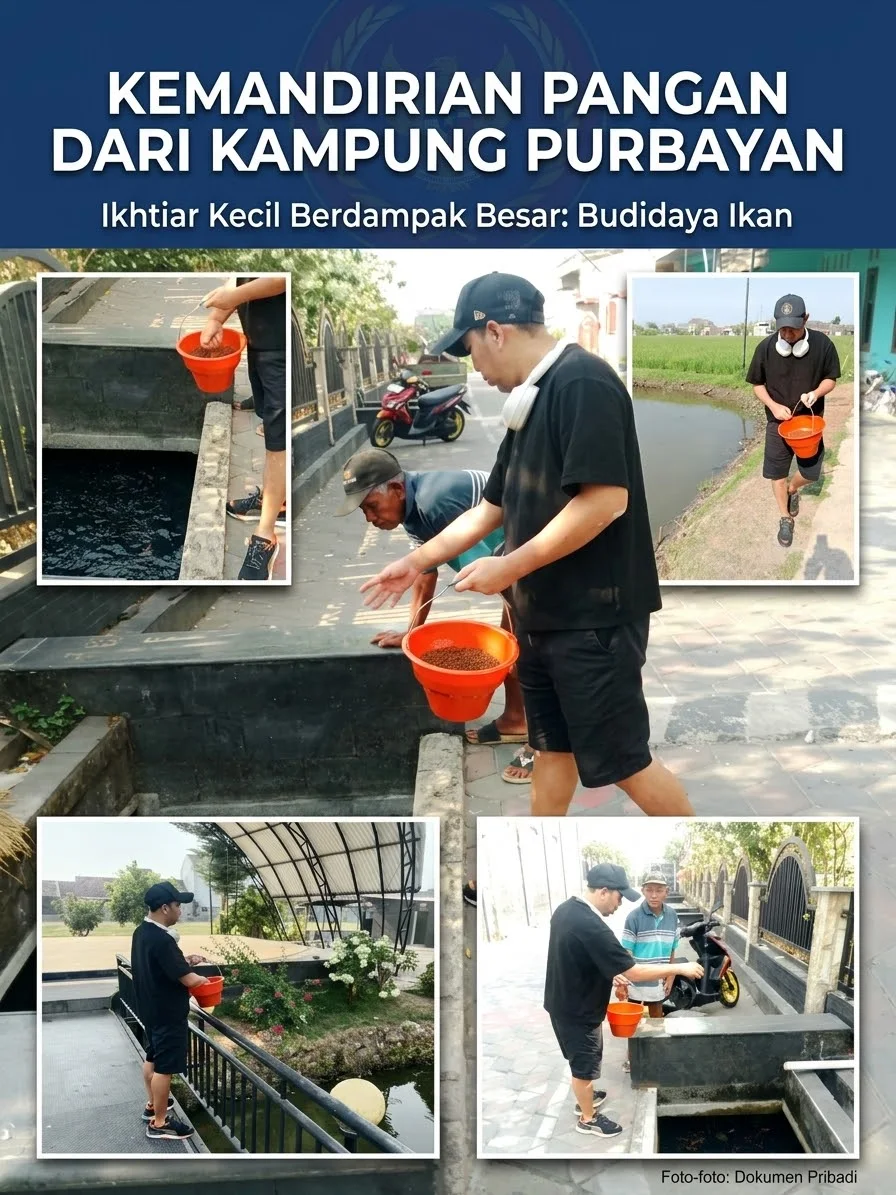
In other words, food security needs to have strong roots within the community.
Don't Always Wait for Mega-Projects
In development, we are sometimes accustomed to thinking that change can only be born from something large.
In reality, various major changes in community life often start from simple steps taken consistently.
A river might look ordinary. But if managed correctly, a river can become part of a fish farming ecosystem.
The fish then become a source of protein. The availability of protein sources can help improve the quality of community nutrition. When a community is able to manage these resources independently, that is the point where the seeds of self-sufficiency begin to grow.
The sequence of the process is actually simple.
Therefore, in building food security, the first question we should ask is not always, “How big of a project must be built?”
A more fundamental question is, “What do we have, and what can we do with what we have?”
Changing the way we ask questions will influence how we view development.
Villages are no longer just recipients of top-down programs. Villages can become places where ideas, innovations, and development practices are born.
The community is not just placed as an object of policy, but as the main actor that understands the conditions and potential of its own region.
Learning from Purbayan, Not Just Imitating
What is being done in Purbayan certainly cannot be directly applied with the same pattern across all regions of Indonesia.
Every region has different geographical characteristics, environmental conditions, water availability, community culture, and management capabilities.
Therefore, the main lesson from Purbayan is not just about fish farming activities or the physical form of the program.
What is more important is the mindset behind it.
Communities need to be encouraged to identify the potential available in their environment, manage it together, and then turn that potential into something that provides tangible benefits.
If a practice is proven to be run well and sustainably, that practice can be studied, improved, and developed into a model that can be adapted in other regions.
Not with a uniform approach, but with the same principles and implementation that adjusts to the character of each region.
In one region, a river can be utilized for fish farming. In another, unproductive land might be developed into a community food garden.
In coastal areas, fishery potential can be strengthened as a food source and an economic driver. Meanwhile, communities in mountainous areas can develop water sources and agricultural land according to their regional conditions.
The form might be different, but the spirit remains the same: managing what we have so that it provides the greatest possible benefit to the community.
Food Security as a Community Movement
If simple practices like this grow in many regions, the benefits obtained are not just related to increased food production.
Furthermore, we are building a culture of self-sufficiency.
Communities learn to identify their potential. They learn to manage resources, build cooperation, share responsibilities, and create mutual benefits.
Ultimately, the community's ability to meet some of its own life needs will also grow stronger.
This is what needs to be one of the perspectives in viewing Indonesia's development.
The state certainly still holds an important role. Policies, regulations, infrastructure development, technology, funding, and government assistance are still needed.
However, development will have much stronger resilience if communities at the grassroots level are also given the space to take initiative and act.
Indonesia is not just Jakarta and not just big cities.
Indonesia consists of thousands of villages and hamlets, each of which has different potential.
There are rivers that continue to flow. There is land that has not been managed optimally. There are vast sea areas. There are communities with various local skills. There is also a young generation that has the energy, creativity, and ability to develop their region's potential.
The challenge is to bring all that potential together with knowledge, good governance, and the willingness to work together.
Starting from Small Things
Purbayan provides a simple reminder that we should not underestimate an effort just because it starts on a small scale.
A movement does not have to be large immediately.
The most important thing is that the movement is real, provides benefits, can be learned from, has good governance, and has the opportunity to continue growing.
From a village, we can learn.
From a river, we can produce food sources.
From fish, we can help meet the community's protein and nutritional needs.
From a community working together, we can build self-sufficiency.
If thousands of small initiatives grow in various regions, the accumulation of their strength can become something very large for Indonesia.
Therefore, perhaps it is time for our way of viewing development to change as well.
Don't always start with questions about what we don't have yet. Start by looking at what is already available around us.
Don't always wait for the arrival of a mega-project. Start with something that can truly be done today.
A strong Indonesia is not only built from the seat of government and big cities. Indonesia is also built by villages that are able to manage their own potential productively and sustainably.
From Purbayan, we learn that a river is not just a flow of water. It can be part of a community's source of life.
Food security is not merely a matter of producing as much food as possible. Within it lies the issue of self-sufficiency, mutual cooperation, resource management, sustainability, and the courage to start.
Start from the river.
Start from the village.
Start from what we have.
Because various major changes often start from small steps taken together consistently.



Comments 0
Write a Comment Share your response