

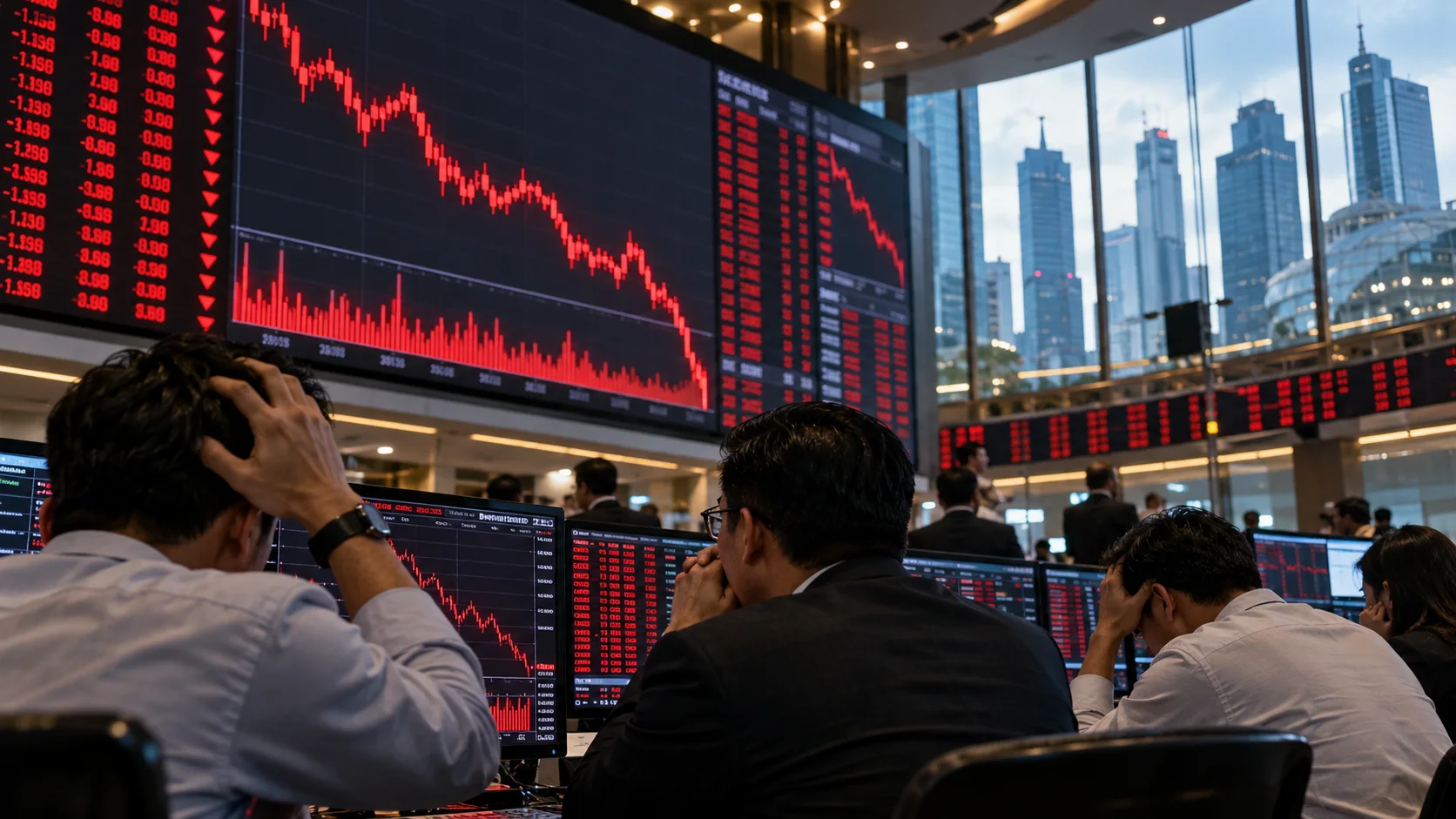
JurnalPost.com - The Indonesian capital market is once again facing a severe test. The collapse of the Indonesia Composite Index (IHSG) on Friday, October 16, 2026, was a pivotal event that shook investor confidence. The index, which stood at 5,863.78 at the close of trading on Thursday (15/10/2026), plummeted to close at approximately 5,185.10, a decline of 11.57 percent in a single day.
The immense selling pressure even forced the Indonesia Stock Exchange (IDX) to temporarily halt trading through a trading haltmechanism. Panic spread, stock prices tumbled, and concerns regarding the future of the national capital market intensified.
However, behind the sea of red numbers on trading screens, a more fundamental question arises: Is the fall of the IHSG merely caused by investor panic, or is it a consequence of unresolved issues regarding transparency and capital market governance?
This question is vital because the capital market does not move solely based on corporate profits; it relies heavily on trust. When that trust is compromised, even companies with relatively strong fundamentals can feel the pressure of the market.
From a financial management perspective, this phenomenon can be understood through several concepts, ranging from information transparency and the risk-return relationship to stock valuation and the health of corporate capital structures.
MSCI Warning and the Fragility of Investor Confidence
One of the primary triggers for the market turmoil was the announcement by Morgan Stanley Capital International (MSCI) on October 15, 2026, regarding a consultation on a proposed reclassification of the Indonesian stock market from Emerging Market to Standalone Market.
The proposal is not a final decision. MSCI is still allowing market participants to provide input until April 30, 2027, with the final decision scheduled to be announced no later than June 30, 2027.
Nevertheless, the announcement was sufficient to trigger significant pressure. MSCI highlighted several issues, particularly the lack of clarity in share ownership structures, allegations of coordinated trading activities, and the need for proof that governance reforms are being effectively implemented.
For global institutional investors, these issues are not merely administrative. Clarity of share ownership and the quality of oversight are essential components in assessing whether a market is a viable investment destination.
In financial theory, this condition relates to asymmetric information, which is the imbalance of information between those with access to specific data and those without.
When investors do not obtain an adequate picture of ownership, liquidity, and stock trading mechanisms, they face higher uncertainty.
As a result, the market risks losing one of its most important assets: trust.
Transparency Is More Than an Administrative Obligation
The principles of transparency and accountability are the primary foundations of Good Corporate Governance (GCG).
Publicly listed companies are required to present reliable financial statements, disclose material information, and provide transparency regarding ownership structures in accordance with applicable regulations.
However, transparency is not achieved solely through the submission of annual reports or formal information disclosures. Investors also require assurance that the price-setting mechanism is fair and not influenced by manipulative practices.
When concerns arise regarding concentrated share ownership or alleged coordinated trading, the credibility of the market mechanism is called into question.
In such situations, investors may no longer focus solely on the profits generated by a company. They must also account for the risks arising from the uncertainty of market governance.
This is where the decline in confidence can translate into pressure on stock prices.
When Risk Increases, Investors Demand Higher Returns
The relationship between risk and return can be explained using the Capital Asset Pricing Model (CAPM), a financial management approach used to estimate the rate of return required by investors.
Simply put, the CAPM formula is expressed as follows:
Ri = Rf + βi (Rm − Rf)
Notes:
Ri: The rate of return required by investors.
Rf: The risk-free rate of return.
βi: Stock beta, a measure of the sensitivity of stock returns to market movements.
Rm: The expected rate of return from the market.
Through this approach, investors assess whether the potential profit of a stock is commensurate with the risk that must be borne.
When uncertainty arises regarding governance and the viability of investment in a country, investors may demand additional risk compensation. In valuation practice, this condition can also be reflected through an increase in the country risk premium.
This means that investments previously considered attractive at a certain rate of return may become less appealing when the perception of risk increases.
If the additional risk is not balanced by adequate profit prospects, some investors may choose to reduce exposure, shift their portfolios, or withdraw funds from the market.
However, this decision does not always happen automatically. Every investor has different strategies, risk tolerances, and investment considerations.
Nevertheless, when many investors adjust their portfolios within a short period, selling pressure can increase significantly.
Why Can Stock Prices Plummet? The Present Value Explanation
The decline in stock prices can also be understood through the concept of Present Value (PV).
In financial management, the value of an asset is essentially related to the present value of the cash flows expected to be received in the future.
One simple form of the calculation is:
PV = FV / (1 + r)^n
Notes:
PV: Present value.
FV: Future value.
r: Discount rate.
n: Number of periods.
The basic principle is clear. When the discount rate increases, the present value of future cash flows will decrease, assuming other factors remain constant.
This concept helps explain why an increase in risk perception can pressure stock valuations even if the company has not experienced major changes in its operational activities.
For example, a company is expected to generate stable cash flows for several years. However, if investors raise the required rate of return because market risk is considered higher, the present value of those cash flows becomes lower.
Consequently, the price investors are willing to pay for the company's stock may also decrease.
This phenomenon is known as repricing, which is the adjustment of asset prices based on changes in expectations and risk.
Large-cap stocks such as BBCA and BBRI are not entirely immune to this condition. Because they have relatively high liquidity, blue-chip stocks are often a key part of institutional investors' portfolio adjustments.
However, a decline in stock prices does not always mean that the company's fundamental conditions have deteriorated to the same extent.
Impact on Solvency and Financial Health of Issuers
Capital market turmoil must also be viewed from the perspective of corporate financial health.
One important aspect is the capital structure, especially the company's ability to meet its debt obligations.
In financial statement analysis, a ratio frequently used is the Debt to Equity Ratio (DER), which is the ratio between total debt and company equity.
DER = Total Debt / Total Equity
Companies with high debt levels generally have more limited financial flexibility when facing economic pressure, especially if their operational cash flow is not strong enough.
Risk can increase if a company has obligations in foreign currencies while most of its revenue is earned in rupiah.
The weakening of the rupiah can increase the value of foreign currency liabilities when converted to rupiah. If the loan interest rates are also floating, rising interest rates can increase the company's interest burden.
This condition has the potential to affect net profit, the ability to pay obligations, and the company's liquidity.
Therefore, investors should not only pay attention to stock price movements. Analysis needs to include profitability ratios such as Net Profit Margin (NPM), Return on Assets (ROA), and Return on Equity (ROE), as well as the quality of operational cash flow.
Research by Hayat, Heniwati, and Rusliyawati (2025) on financial distress analysis demonstrates the importance of using financial approaches to assess a company's potential for financial difficulty.
Meanwhile, research by Yudhistira and Indriastuti (2024) confirms that macroeconomic variables, including inflation, exchange rates, and interest rates, are linked to the movement of the IHSG.
Both studies show that investment decisions should be based on a broader analysis rather than simply following market sentiment.
Does the IHSG Fall Only Harm Market Players?
The debate regarding the impact of a stock market crash is also interesting when linked to statements by President Prabowo Subianto.
In his speech at the Tanwir Session and the 112th Muhammadiyah Anniversary Reception in Kupang on December 4, 2024, Prabowo touched on the issue of falling stock indices while discussing responses to the nutritious meal program idea.
“If stocks fall, yes, those are the market players,” said President Prabowo Subianto in the speech.
That statement was made long before the market turmoil of October 2026, so it cannot be positioned as a direct response to the MSCI announcement.
From an investment standpoint, shareholders are indeed the parties who most directly feel the decline in portfolio value when stock prices fall.
However, the impact of the capital market does not always stop with investors.
The stock market is a source of corporate financing. A prolonged decline in confidence has the potential to increase the cost of raising capital, hinder business expansion, and ultimately affect economic activity.
In addition, the public may also have indirect exposure to the capital market through mutual funds, pension funds, or other investment instruments.
Therefore, maintaining the stability and integrity of the capital market is not merely a matter of protecting investor profits, but is also related to the health of the economic financing system.
A Test for the IDX and OJK: Reform Must Be More Than Just a Promise
The fall of the IHSG should be a momentum for a comprehensive evaluation of Indonesia's capital market governance.
The Financial Services Authority (OJK) has expressed its commitment to strengthening market reform, including improving share ownership transparency, refining free floatregulations, trading oversight, and law enforcement.
These efforts are important steps. However, the real challenge lies in the consistency of implementation and measurable results.
Global investors need more than just policy announcements. They require proof that trading mechanisms are becoming more transparent, violations are being adequately addressed, and information provided to the public is reliable.
The MSCI consultation period until April 2027 is an opportunity for Indonesian capital market authorities to demonstrate tangible progress before the final decision is made.
If improvements are successfully implemented consistently, investor confidence has a chance to recover. Conversely, if fundamental issues remain unresolved, the risk of declining attractiveness for the Indonesian stock market may continue to loom.
IDX Karma or a Rational Economic Consequence?
Calling the fall of the IHSG "karma" is certainly a simplification of complex economic issues.
The stock market is influenced by many factors, ranging from macroeconomic conditions, monetary policy, geopolitical situations, and corporate performance to investor behavior.
However, issues of transparency and governance cannot be separated from how investors assess risk.
When information disclosure is questioned, investors may demand a higher risk premium. When the risk premium increases, stock valuations are potentially pressured. And when confidence weakens simultaneously, selling actions can develop into broader market pressure.
From a financial management perspective, this sequence is a rational economic consequence, not merely an emotional market punishment.
For investors, this event serves as a reminder not only to pursue short-term profits but also to pay attention to fundamentals, debt structures, cash flow quality, and corporate integrity.
Meanwhile, for the IDX, OJK, and all stakeholders, the message that emerges is much more fundamental: trust cannot be built solely through optimism; it must be proven through transparency, accountability, and consistent enforcement of rules.
Ultimately, a healthy capital market is not one that always experiences price increases. A healthy capital market is one that is capable of providing reliable information, forming prices fairly, and providing fair protection to all investors.
If that foundation is strengthened, market turmoil can become a learning moment. However, if the same issues continue to be ignored, every new crisis will only repeat the old question: has the Indonesian capital market truly been managed transparently?
Bibliography
Hayat, A., Heniwati, E., & Rusliyawati, R. (2025). Analisis financial distress dengan model Z-Score, S-Score, dan X-Score. AKUA: Jurnal Akuntansi dan Keuangan, 4(4), 695–706. DOI: 10.54259/akua.v4i4.5600.
MSCI Inc. (2026, October 15). MSCI launches a consultation on a proposal to reclassify Indonesia from Emerging Market to Standalone Market status.
Financial Services Authority (OJK). (2026). OJK berkomitmen untuk terus melanjutkan dan memperkuat reformasi pasar modal Indonesia.
Cabinet Secretariat of the Republic of Indonesia. (2024, December 4). Sambutan Presiden Prabowo Subianto pada Pembukaan Sidang Tanwir dan Resepsi Milad ke-112 Muhammadiyah.
Yudhistira, F., & Indriastuti, D. R. (2024). Pengaruh inflasi, kurs dan BI Rate terhadap Indeks Harga Saham Gabungan (IHSG) periode 2015–2022. Jurnal Riset Manajemen, 2(3), 158–167. DOI: 10.54066/jurma.v2i3.2246.



Comments 0
Write a Comment Share your response