


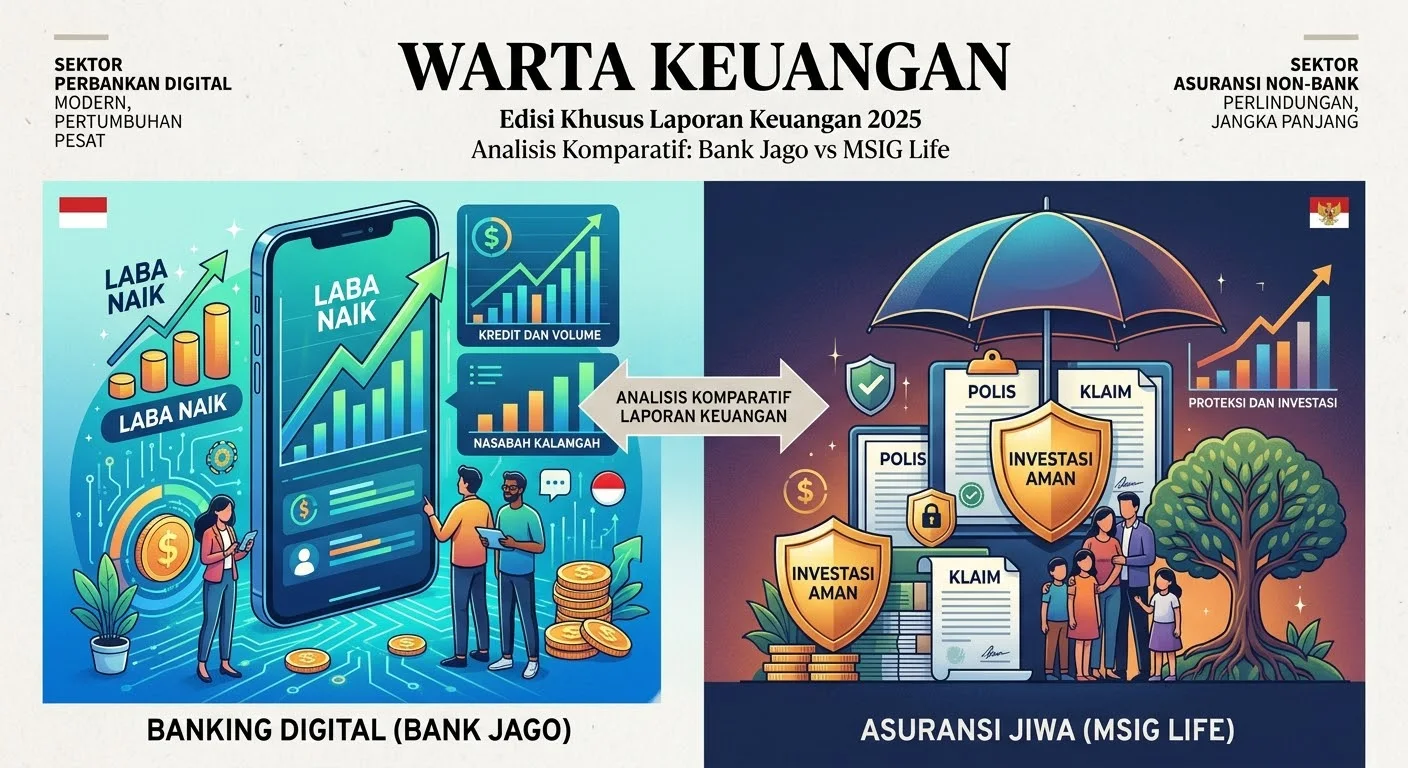
Bank Jago's profit surged more than twofold, while MSIG Life saw significant premium growth despite a decline in profit. This discrepancy illustrates that the financial statements of banks and insurance companies possess distinct characteristics and 'languages.'
JAKARTA, JurnalPost.com — Financial reports serve as a vital instrument for assessing a company's condition and performance. For companies listed on the Indonesia Stock Exchange (IDX), these reports also act as a reference for investors to evaluate business growth, risk levels, and future prospects.
For the 2025 fiscal year, PT Bank Jago Tbk (ARTO), which operates in the digital banking sector, and PT MSIG Life Insurance Indonesia Tbk (LIFE), which conducts life insurance business, both recorded growth in their core business activities.
However, the profit trajectories of the two companies differed.
Bank Jago posted a surge in net profit, while MSIG Life recorded growth in premium income but experienced a decline in profit. This condition demonstrates that even though both are in the financial services industry, the financial reports of banks and insurance companies cannot be interpreted using the exact same approach.
Bank Jago: Profit More Than Doubles
Throughout 2025, Bank Jago recorded a net profit after tax of Rp276 billion. This figure represents an increase of approximately 115 percent compared to the 2024 profit of Rp129 billion.
This profit growth went hand-in-hand with the expansion of credit disbursement and an increase in funds collected from customers.
Bank Jago's credit disbursement reached Rp24.3 trillion, growing by approximately 38 percent compared to Rp17.7 trillion the previous year. Third-party funds (DPK) also increased by 38 percent, from Rp18.8 trillion to Rp25.9 trillion.
Bank Jago's total assets in 2025 were recorded at Rp36.5 trillion, an increase of approximately 28 percent from Rp28.5 trillion the previous year.
Business growth is also evident in the number of customers, which has reached 18.2 million. Of that total, approximately 14.2 million are funding customers who use the Jago and Jago Syariah applications.
Regarding credit quality, Bank Jago recorded a gross non-performing loan non-performing loan (NPL) ratio of 0.6 percent. Meanwhile, the loan to deposit ratio (LDR) was recorded at the 94 percent level.
Bank Jago President Director Arief Harris previously explained that the increase in the number of customers has a strong correlation with the growth of third-party funds. The broader the user base, the greater the bank's opportunity to increase public fund collection.
MSIG Life: Premiums Grow Amid Industry Pressure
Unlike Bank Jago, MSIG Life's business growth in 2025 was primarily visible in its premium income.
The company recorded premium income of approximately Rp4.45 trillion, an increase of 36.92 percent year-on-year. Additionally, the company booked investment returns of approximately Rp1.01 trillion.
Throughout the year, MSIG Life paid gross claims of Rp1.16 trillion and recorded a current year profit of Rp206.23 billion.
Although still profitable, this amount fell by approximately 44.52 percent compared to the 2024 profit, which reached Rp371.69 billion.
One factor influencing this performance was the rise in insurance service expenses. These expenses increased by 35.18 percent to approximately Rp2.03 trillion.
This condition shows that an increase in premiums does not always automatically result in profit growth. Insurance companies must also account for claim payment obligations, benefits to policyholders, acquisition expenses, operational costs, and investment results.
MSIG Life's total assets at the end of 2025 were recorded at approximately Rp15.87 trillion.
The company's premium growth performance is quite interesting when compared to industry conditions. Data from the Financial Services Authority (OJK) shows that life insurance industry premium income as of September 2025 experienced a year-on-year decline of approximately 2.06 percent to Rp132.85 trillion.
MSIG Life Director and Chief Transformation Officer Ken Terada attributed the company's business growth to increasing public awareness of the importance of insurance protection and support for the company's operational strengthening.
Key 2025 Performance Figures
| Indicator | Bank Jago (ARTO) | MSIG Life (LIFE) |
|---|---|---|
| Sector | Banking | Life Insurance/Non-Banking |
| Profit after tax/current year profit | Rp276 billion, up 115% from Rp129 billion | Rp206.23 billion, down 44.52% from Rp371.69 billion |
| Main growth source | DPK Rp25.9 trillion, up 38%; credit Rp24.3 trillion, up 38% | Premium income Rp4.45 trillion, up 36.92%; investment returns ~Rp1.01 trillion |
| Total assets | Rp36.5 trillion, up 28% | Approximately Rp15.87 trillion |
| Operational/health indicators | Gross NPL 0.6%; LDR 94% | Gross claims Rp1.16 trillion |
Differences in Key Financial Statement Components
| Component | Bank Jago (ARTO) | MSIG Life (LIFE) |
|---|---|---|
| Statement of Financial Position | Main assets consist of loans granted and placements with BI and other banks. Liabilities primarily stem from third-party funds in the form of current accounts, savings, and deposits. | Assets largely originate from investment portfolios such as bonds, stocks, and mutual funds. Main liabilities include insurance contract obligations or reserves to meet obligations to policyholders. |
| Income Statement | Revenue primarily comes from interest, sharia income, and fee-based income. Expenses include interest expenses, operational costs, and impairment losses or CKPN. | Revenue relates to insurance services, premiums, and investment returns. Expenses include insurance services, claim and benefit payments, as well as acquisition and operational costs. |
| Cash Flow Statement | Relates to deposit collection, credit disbursement and repayment, and various fund placement activities. | Relates to receipts from insurance activities, claim and benefit payments, and investment activities. |
| Statement of Changes in Equity | Includes paid-in capital, additional paid-in capital or share premium, and retained earnings. | Includes share capital, additional paid-in capital, retained earnings, and components of investment value changes recorded in equity according to accounting standards. |
Three Main Differences Between Bank and Insurance Company Reports
The first difference lies in the asset and liability structure.
Banks function as intermediary institutions that collect public funds to be redistributed, one way being through credit. Therefore, credit becomes a key component on the asset side, while third-party funds are the main component of liabilities.
Insurance companies have a different character. The company accepts risk from policyholders in exchange for premiums. These funds are then managed, including through various investment instruments, so that the company can meet future benefit and claim payment obligations.
The second difference is in the sources of income and expenses.
In banking, the ability to generate profit is determined by factors such as interest income or margins from fund disbursement, the cost of funds, fee-based income, operational efficiency, and credit risk costs.
Meanwhile, an insurance company's performance is influenced by income from insurance activities, claim and benefit payments, operational costs, acquisition costs, and investment performance.
The third difference is the financial health indicators used.
Bank performance can be analyzed using indicators such as NPL to view credit quality, capital adequacy ratio (CAR) for capital adequacy, net interest margin (NIM) to measure net interest margin, and LDR to view the ratio of credit to third-party funds.
For insurance companies, one indicator that receives significant attention is risk-based capital (RBC), which describes the company's capital adequacy level in facing risks arising from insurance business activities.
A Message for Investors
The profit difference between Bank Jago and MSIG Life cannot be used directly to conclude that one sector is better than the other.
Banks and insurance companies have different business models, balance sheet structures, income sources, risks, and liability characteristics.
Bank Jago, for instance, recorded a profit of Rp276 billion with strong credit and third-party fund growth. On the other hand, MSIG Life succeeded in increasing premium income to Rp4.45 trillion, but rising expenses caused the company's profit to fall to Rp206.23 billion.
Therefore, investors should not merely compare profit nominals.
Bank performance needs to be assessed through credit quality, capital adequacy, liquidity, margins, and the ability to collect and disburse funds. Meanwhile, insurance companies need to be analyzed through insurance business growth, claim payments, investment returns, risk-based capital adequacy, and the ability to meet obligations to policyholders.
Understanding the character of each sector's financial reports can help investors obtain a more objective picture before making investment decisions in the capital market.
Source: Financial reports and news regarding the performance of Bank Jago and MSIG Life for the 2025 fiscal year from Bisnis.com, Kontan, IDX Channel, and Infobanknews; MSIG Life financial reports as of December 31, 2025, published through the Indonesia Stock Exchange; and industry data from the Financial Services Authority (OJK).



Comments 0
Write a Comment Share your response