

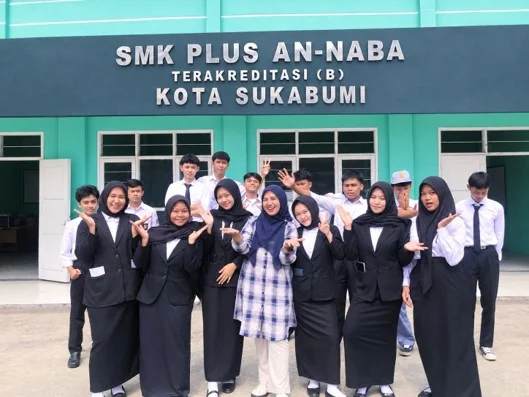
JurnalPost.com - Vocational High Schools (SMK) play a vital role in preparing a skilled, independent generation ready for the workforce. Unlike general education, vocational learning requires more than just theoretical understanding; it demands practical experience aligned with the needs of the business and industrial sectors.
One inspiring learning model is the Mini Bank program at SMK Plus An-Naba. This program provides hands-on experience for students in the Office Management and Business Services (MPLB) competency program through simple financial services and administrative activities within the school environment.
Through the Mini Bank, students have the opportunity to apply classroom knowledge to activities that mirror real-world work situations, ranging from customer service and transaction recording to document filing and administrative report preparation.
The existence of this program demonstrates that vocational learning can be developed creatively by utilizing the school environment as a practical space relevant to students' competencies.
Understanding the Mini Bank Program at SMK Plus An-Naba
The Mini Bank is a learning unit designed to provide students with experience in managing simple financial administration services.
At SMK Plus An-Naba, this program serves as a practical training ground for MPLB students under the guidance of teacher Iqbal Abdul Rachman.
Activities include simulations of opening savings accounts, processing deposits and withdrawals, recording transactions, managing documents, and preparing simple financial reports.
Through these activities, students not only understand administrative procedures but also learn to communicate with service users, work in a structured manner, and take responsibility for assigned tasks.
The Mini Bank program is part of a contextual learning approach that bridges theory and practice, allowing students to see firsthand how service and administrative procedures are applied in a workplace.
Consequently, this is not merely an extracurricular activity but a learning medium to strengthen vocational competence.
Developing MPLB Student Competencies Through Hands-On Practice
The Office Management and Business Services competency focuses on the ability to manage administration, provide services, utilize office technology, and conduct professional business communication.
The Mini Bank program provides a space for students to develop these various skills.
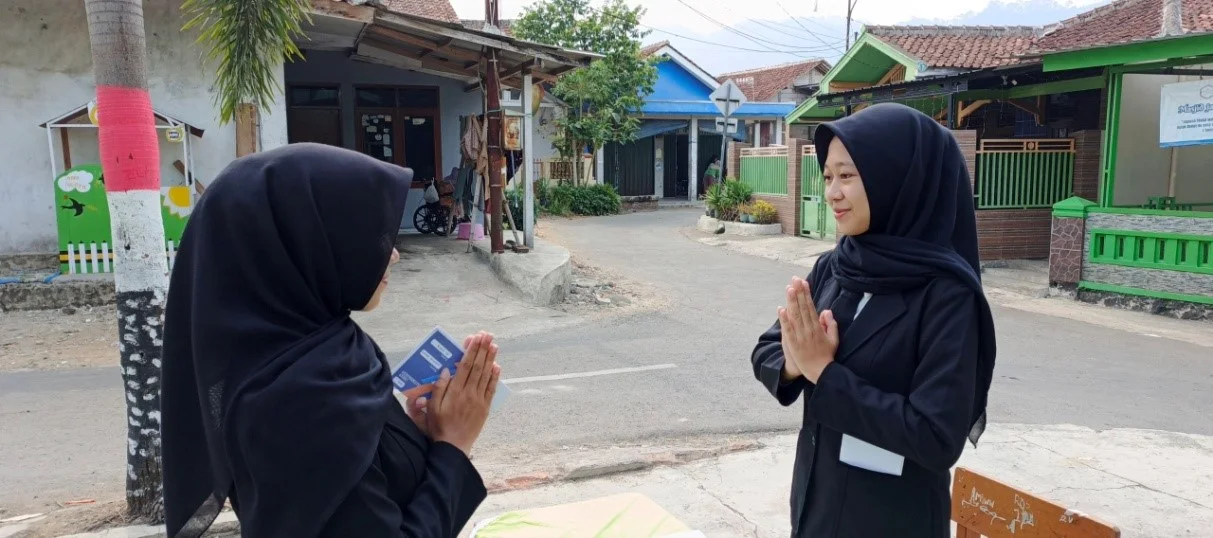
In the aspect of excellent service or customer service, for example, students are trained to greet service users, provide information, and handle needs with polite and professional communication.
In administration and archiving, students practice form recording, managing transaction evidence, document preparation, and systematic data filing.
Meanwhile, simple financial management skills are acquired through transaction recording, balance calculations, and report preparation, which require high precision.
The use of spreadsheet applications and administrative software is also applied to introduce technology commonly used in modern office environments.
Equally important, this activity helps build a work culture that emphasizes discipline, honesty, responsibility, teamwork, and accuracy.
Through the division of roles and service schedules, students learn to understand their individual responsibilities while recognizing the importance of coordination in running a service unit.
The Mini Bank from an Educational Foundation Perspective
The implementation of a Mini Bank in a school setting relates to various concepts in educational foundations, including philosophical, psychological, sociological, and legal aspects.
From a philosophical perspective, this program aligns with the learning by doing concept associated with educational philosopher John Dewey.
This approach emphasizes the importance of direct experience in the learning process. Students do not just receive information from teachers but engage in activities that allow them to understand the real-world application of knowledge.
In the context of the Mini Bank, concepts of service, administration, and document management previously studied in theory can be practiced through activities that resemble the professional world.
From a psychological standpoint, students at the vocational level are at a developmental stage that requires opportunities to build independence, self-confidence, and responsibility.
When taking on roles as service officers or administrative managers, students have the chance to develop decision-making, communication, and independent task-completion skills under teacher supervision.
Sociologically, schools are social environments that prepare students to interact with the community.
The Mini Bank program provides experience in collaborating, serving others, adhering to procedures, and resolving problems through effective communication.
From the perspective of educational policy, strengthening practice-based learning aligns with the spirit of vocational education revitalization as stipulated in Presidential Regulation Number 68 of 2022 regarding the Revitalization of Vocational Education and Training.
This activity is also relevant to the contextual and project-based learning approaches developed within the Merdeka Curriculum.
Benefits of the Mini Bank for Students and Schools
The Mini Bank program offers several benefits for students, teachers, and the school environment.
For students, this activity is an opportunity to develop technical skills or hard skills as well as non-technical skills or soft skills.
The ability to serve, communicate, work in teams, operate administrative devices, and manage documents can be trained through daily activities.
Additionally, students are introduced to the importance of financial literacy, saving habits, and responsible financial management.
For teachers, the Mini Bank serves as a learning medium that helps connect vocational material with practical experience. Assessment is not based solely on written exam results but also on observations of students' abilities while performing tasks.
For the school, this program has the potential to strengthen the quality of vocational learning while opening opportunities for partnerships with financial institutions to support education and training.
For the school community, a well-designed and supervised program can serve as an educational tool regarding financial services and the importance of orderly administrative management.
Opportunities for Implementing Mini Banks in Other Vocational Schools
The Mini Bank concept does not require expensive facilities or complex systems. Schools can start with simple administrative service simulations tailored to available resources and student capabilities.
The first step is to define program objectives and link them to learning outcomes in vocational subjects.
Next, schools can form a management team consisting of supervising teachers and students with clear task divisions.
Students can be assigned roles as service officers, transaction recorders, document managers, or administrative report coordinators.
Schools also need to prepare Standard Operating Procedures (SOPs) that govern service flow, recording, supervision, and activity evaluation.
In the initial stages, the use of simple forms, logbooks, computers, and spreadsheet applications can be sufficient to run simulations.
If the program involves managing real money, schools must ensure security, supervision, and compliance with applicable regulations. Partnering with official financial institutions can be an option to support secure fund management.
Once the program is running, periodic evaluations are necessary to assess student skill development and the effectiveness of the learning activities.
Management Challenges and the Importance of Teacher Supervision
Despite the benefits, implementing a Mini Bank has challenges that must be addressed.
One relates to administrative precision and accountability in fund management if the activities involve real financial transactions.
Therefore, supervising teachers must ensure that every activity is carried out based on clear procedures and under adequate supervision.
Limited facilities can also be an obstacle, especially for schools that do not yet have dedicated practice rooms or complete administrative equipment.
However, this condition should not hinder the program's implementation. Activities can start on a small scale through service simulations focused on competency development.
Other challenges relate to student readiness in performing tasks. Initial training, appropriate role distribution, and ongoing supervision are essential to building skills and self-confidence.
In its implementation, schools must clearly distinguish between the Mini Bank as a learning tool and actual banking business activities, which have their own licensing requirements.
Preparing Competent and Work-Ready Vocational Graduates
The Mini Bank program at SMK Plus An-Naba demonstrates how vocational learning can be designed to be closer to the needs of the professional world.
Through practice in service, administration, documentation, and simple financial management, students gain experience that serves as a foundation when entering the professional world.
This type of learning is not only oriented toward mastering material but also toward character building, work ethics, and the ability to complete tasks responsibly.
The existence of the Mini Bank can inspire other vocational schools in Indonesia to develop practice-based learning models according to their respective characteristics and potential.
With the support of teachers, school management, and appropriate partnerships, similar programs have the potential to strengthen the quality of vocational education.
Ultimately, the success of vocational education is determined not only by the amount of theory students master but also by their ability to apply that knowledge and those skills in real life.
References
Dewey, J. (1938). Experience and Education. New York: Kappa Delta Pi.
Ministry of Education, Culture, Research, and Technology. Merdeka Curriculum Documents and Pancasila Student Profile.
Presidential Regulation of the Republic of Indonesia Number 68 of 2022 regarding the Revitalization of Vocational Education and Training.




Comments 0
Write a Comment Share your response