

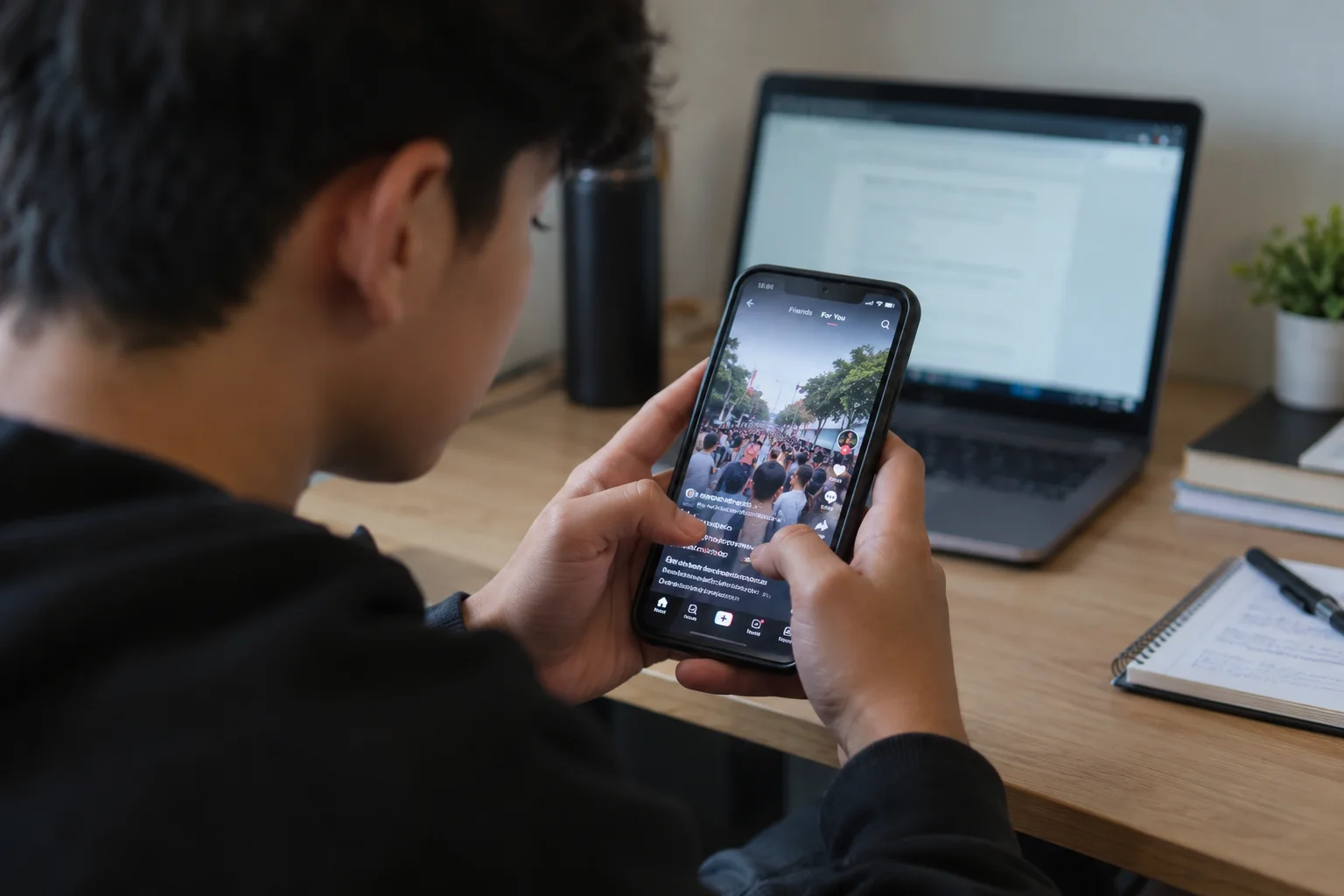
JurnalPost.com - Social media has become an inseparable part of daily life. From the moment they wake up until late at night, many people are accustomed to checking their phones to view information, follow trends, watch videos, or simply read comments on social media. The activity of scrolling has even become a habit performed almost unconsciously.
Behind the convenience and entertainment offered, social media also presents various challenges. The spread of fake news or hoaxes, hate speech, provocations, and debates that lead to hostility are increasingly easy to find in the digital space.
These issues serve as a reminder that technological progress must be balanced with moral awareness and social responsibility. In the Indonesian context, Pancasila plays a crucial role as a guide for shaping societal behavior, including when interacting in the virtual world.
Pancasila should not just be understood as five principles memorized in school. Its values need to be applied in simple actions, from choosing information and expressing opinions to respecting differences on social media.
Social Media Opens Opportunities, But Also Creates Problems
It cannot be denied that the development of social media brings many benefits. People can obtain information quickly, communicate across borders, develop businesses, and expand their knowledge through various educational content.
However, this convenience also opens opportunities for the spread of unverified information. Content that triggers emotions, incites anger, or marginalizes certain groups often attracts attention faster than information presented in a complete and balanced manner.
A video clipped from its original context, for example, can lead to misunderstandings. The same applies to sensational headlines intentionally created to pique the reader's curiosity.
When such information is shared repeatedly without verification, the impact can be widespread. People who were previously unaware of the actual issue may become provoked and form judgments based on incorrect information.
Therefore, the public needs to realize that the freedom to use social media is always accompanied by responsibility for the information shared.
Don't Become a Spreader of Hoaxes
One of the problems that often arises on social media is the habit of sharing information without first verifying its truth.
Many users forward posts simply because the headline is interesting or aligns with their personal views. In reality, information that looks convincing is not necessarily supported by facts.
Hoaxes can be created for various purposes, ranging from seeking attention and gaining profit to shaping opinions or bringing down certain parties.
The spread of false information not only harms the targets but can also cause unrest and damage relationships between community members.
In such situations, the values of honesty, responsibility, and social concern contained in Pancasila become highly relevant.
Before sharing information, social media users should check the source, read the full content of the news, and compare it with reports from credible media outlets.
If the truth remains doubtful, the best choice is not to share it.
Being a wise social media user does not mean having to know everything. Rather, the ability to restrain oneself when encountering unclear information is a form of responsibility in digital life.
Differing Opinions Should Not Lead to Mutual Destruction
The comment section is one place that shows how society handles differences of opinion.
In a post, people can express diverse views. Such differences are natural, especially since Indonesia is a country with a society that has different backgrounds, experiences, and thoughts.
Unfortunately, debates on social media sometimes turn into personal attacks. Criticism of an opinion shifts into insults, mockery, and even hate speech.
In fact, the second principle of Pancasila, Just and Civilized Humanity, teaches the importance of respecting the dignity of every human being.
This value also applies when someone communicates through a phone screen. Freedom of speech should not be an excuse to demean or embarrass others.
One can still deliver firm criticism without using harsh words. Differing views can even become a space for learning if conveyed through healthy discussion.
It must be remembered that behind every social media account is a human being with feelings and a real life.
A comment written in a matter of seconds may seem trivial to the sender, but it can leave a lasting impact on the recipient.
Diversity Must Be Preserved, Not Used for Provocation
Indonesia is known as a country with a diversity of ethnicities, religions, languages, and cultures. This wealth is an important part of the national identity that must be guarded together.
However, diversity can also become a target for provocation if used to build prejudice and hatred against certain groups.
On social media, issues related to religion and identity often trigger sensitive debates. It is not uncommon for a post to be created with a narrative intentionally pitting one group against another.
In such conditions, the practice of the first principle, Belief in the One and Only God, can be manifested through an attitude of respecting the religious freedom and beliefs of others.
Meanwhile, the third principle, The Unity of Indonesia, reminds us that differences should not be an excuse to damage brotherhood as fellow citizens.
When encountering content that contains insults toward a religion, ethnicity, or specific group, the public should not participate in spreading it further.
Reporting content that violates platform rules, providing clarification based on facts, and prioritizing polite dialogue are more beneficial steps than responding to provocation with hatred.
National unity is not only maintained through major events or national commemorations, but also through simple decisions when using social media.
Pancasila as a Moral Guide in the Digital World
Technological development does not reduce the relevance of Pancasila. On the contrary, the rapid flow of information makes the nation's basic values even more necessary.
The five principles of Pancasila can serve as a guide in building more responsible digital habits.
The first principle teaches the importance of respecting the religion and beliefs of others. In using social media, this value can be applied by not spreading content that insults or provokes religious conflict.
The second principle reminds everyone to treat their fellow human beings humanely, including by avoiding digital bullying, insults, and personal attacks.
The third principle emphasizes the importance of maintaining unity. Social media users need to be careful about information intentionally created to incite conflict among the public.
The fourth principle, Democracy Guided by the Inner Wisdom in the Unanimity Arising Out of Deliberation Amongst Representatives, teaches the importance of prioritizing mature consideration, listening to the opinions of others, and resolving differences through dialogue.
As for the fifth principle, Social Justice for All the People of Indonesia, it reminds us that technological development should provide equitable benefits, including for communities that still face limited access and digital capabilities.
Thus, Pancasila is not just a state symbol, but a guide that can be applied in facing the challenges of modern life.
Becoming a More Responsible Social Media User
Creating a healthy digital space does not have to start with big steps. Change can be made through simple habits applied consistently.
Reading information to the end before responding is one example. This habit helps reduce misunderstandings caused by only reading headlines or seeing snippets of posts.
In addition, social media users need to get into the habit of verifying the truth of information before sharing it with others.
When encountering a different opinion, try to respond with polite language and based on clear reasoning.
If you find content that contains hate speech or provocation, avoid spreading it. Use the reporting facilities available if the content violates the rules.
No less important, the public also needs to be more active in spreading beneficial information, such as educational content, social activities, culture, and various forms of cooperation that strengthen brotherhood.
Social media actually has great potential to be a space that brings together people from various backgrounds. This potential will provide benefits if used with awareness and responsibility.
Scroll All You Want, But Unity Must Be Maintained
Ultimately, social media is just a tool. Its positive or negative impact depends heavily on how humans use it.
The habit of scrolling, uploading content, commenting, and sharing information is an unavoidable part of digital life. However, every such activity still requires moral consideration.
Do not let the ease of communication make it easier for people to fight. Nor should differences of opinion become an excuse to hate one another.
Pancasila is not enough to just be spoken in ceremonies or memorized as part of school lessons. Its values need to be present in real actions, including when someone holds a phone and interacts with others through social media.
Choosing to verify facts rather than spreading hoaxes, prioritizing politeness over insults, and maintaining unity rather than following provocation are simple forms of practicing Pancasila.
Therefore, there is nothing wrong with enjoying social media as long as it is done wisely. Technology may continue to develop, but the values of humanity, tolerance, and unity must not be left behind.
Scroll all you want, differ in opinion all you want, but do not let our thumbs be the cause of national division.






Comments 0
Write a Comment Share your response