

JurnalPost.com - Recruitment and talent selection have long been associated with the professional world, particularly when companies seek candidates who align with organizational needs. Recruitment is conducted to attract potential employees, while selection aims to assess an individual's abilities, skills, character, and potential before placing them in a specific role.
However, upon closer inspection, the principles of recruitment and talent selection can actually be found in various daily activities. One of the simplest examples is group work within an educational setting.
Through the study of Talent Recruitment and Selection, we can understand that every individual possesses different abilities, character traits, and strengths. These differences do not always hinder collaboration. On the contrary, when recognized and managed correctly, diverse capabilities can become a strength in achieving common goals.
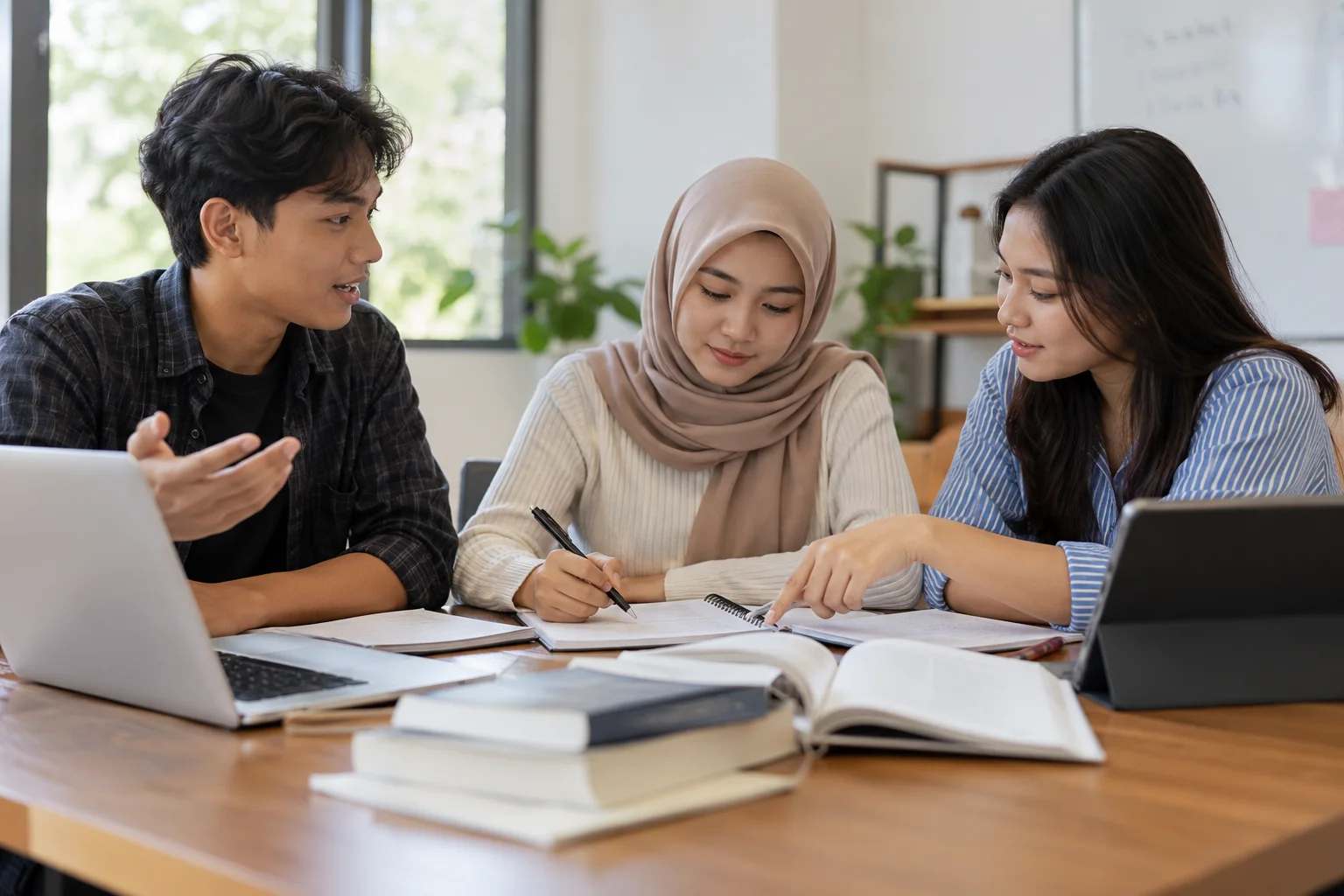
This experience can be observed in a three-person group consisting of Rochmat, Dewi S, and Hati D. The three have different characteristics and potential, yet they can complement each other in completing tasks.
Recognizing the Potential of Each Group Member
In group work, task distribution is a key factor in determining the smoothness of the workflow. This distribution should not be done haphazardly but should consider the abilities and character of each member.
Rochmat, for instance, possesses strong self-confidence and the courage to express opinions. These characteristics demonstrate his potential in communication, leadership, and presenting ideas.
Rochmat's confidence can be an asset when the group needs to discuss, make decisions, or present work results to others.
Based on these abilities, Rochmat is considered suitable for the role of group coordinator or presenter. In this position, he can help guide discussions, coordinate task distribution, and present the final work more persuasively.
Meanwhile, Dewi S has characteristics that are more prominent in terms of meticulousness and the ability to organize information systematically.
Meticulousness is a crucial skill in completing group tasks. A project requires not only interesting ideas but also accurate information, coherent discussion, and a presentation of material that is easy to understand.
With these characteristics, Dewi S can take on the role of researching references, processing information, and compiling group materials.
This role helps ensure that the work has a clear foundation and is well-structured before it is presented.
Unlike the other two members, Hati D has potential in fostering collaboration, communicating, and providing feedback on the work.
This ability is essential for creating an open discussion atmosphere. Group work does not rely solely on members who can lead or compile materials; it also requires someone who can help evaluate the work.
Therefore, Hati D can take on the role of analyzing materials, providing additional ideas, and double-checking the final output.
Through this role, Hati D helps ensure that the group's work aligns with the objectives and that no important parts are overlooked.
Applying the Principle of The Right Person in the Right Position
Distributing tasks based on each member's abilities reflects one of the most important principles in human resource management, namely the right person in the right position.
This principle emphasizes the importance of placing someone in a position or responsibility that matches their abilities, skills, and potential.
In this group work experience, Rochmat contributes through coordination and presentation, Dewi S plays a role in information processing and material compilation, while Hati D supports the analysis and evaluation process.
Although they have different responsibilities, all three work toward the same goal.
Such task distribution does not mean limiting someone's ability to a single field. Each member still has the opportunity to learn, develop new skills, and assist with other members' work.
In fact, through proper role distribution, the group can work more effectively because every member understands their responsibilities and the expected contributions.
This demonstrates that the principle of talent selection does not always have to be applied through formal processes like interviews, aptitude tests, or psychological assessments. In simple activities like group work, understanding individual capabilities can also serve as a basis for determining responsibilities.
Collaboration is More Important than Determining Who is the Best
One important lesson from this experience is that recognizing talent is not the same as determining who is the smartest or most superior.
In a group, every individual may have strengths in different areas. Some are more confident when speaking, some are meticulous in processing information, and others are capable of maintaining communication and helping evaluate work.
If all members only want to take on the same role, the group work process may become less effective. Conversely, when each member understands their own strengths and responsibilities, the work can be completed in a more organized manner.
This understanding is also relevant to the professional world.
Companies need human resources with various competencies. Not all positions require the same characteristics or skills. Therefore, a good selection process needs to consider the fit between individual abilities and job requirements.
The same applies to group work. Success is not determined solely by one person's ability, but also by the quality of communication, the distribution of responsibilities, and the willingness of each member to help one another.
Through this collaboration, each individual can contribute according to their potential while learning to appreciate the abilities of others.
Reflections on the Group Work Experience
The experience of working with Rochmat, Dewi S, and Hati D provides an understanding that the concept of Talent Recruitment and Selection is not just a theory used by companies to find employees.
The concept also teaches the importance of recognizing one's own potential and that of others, understanding character differences, and building collaboration based on each individual's abilities.
From this simple experience, we can learn that a group does not have to consist of people with the same abilities to produce good work.
In fact, differences in ability can become a strength if each member respects one another, fulfills their responsibilities, and is committed to the common goal.
Ultimately, the success of a group is not just about who stands out the most, but how each individual is able to provide their best contribution.
Talent selection is not merely about finding the most superior person, but also about recognizing the potential of every individual and placing them in the right responsibility.
This lesson applies not only in the professional world but also in daily life, including through simple experiences like completing group assignments.







Comments 0
Write a Comment Share your response