


JurnalPost.com — The name Nanang Emoh has gained recognition through comedy content that offers a distinct perspective. Rather than relying on luxurious settings or urban backdrops, he transports his audience to a simpler world: village roads, rice fields, rural homes, and folklore.
Behind the name Nanang Emoh is Nanang Saputra. Born in South Lampung on March 17, 2002, he is a content creator and artist with a formal background in performing arts.
Nanang’s content often draws from the nuances of daily life. Romance, family dynamics, human relationships, Javanese culture, and folklore are all infused with his signature imagination and absurd humor.
The result is a comedic world that is simple yet instantly recognizable.
Nanang notes that this proximity to everyday life is a crucial part of his creative process.
“I prefer to highlight things that are close to daily life. Simple things can actually become interesting stories when we look at them from a different angle,” Nanang Emoh told JurnalPost in an interview via WhatsApp.
From the Word “Emoh” to an Identity
The name “Emoh” is more than just a stage name.
In Javanese, emoh roughly translates to “don't want to” or “refuse.” This simple word has evolved into a core part of the persona Nanang has built on social media.
Phrases like “emoh aku emoh” have become punchlines, character responses, and a recognizable trademark for his audience.
Nanang admits that the word fits perfectly with the character and style of humor he has developed.
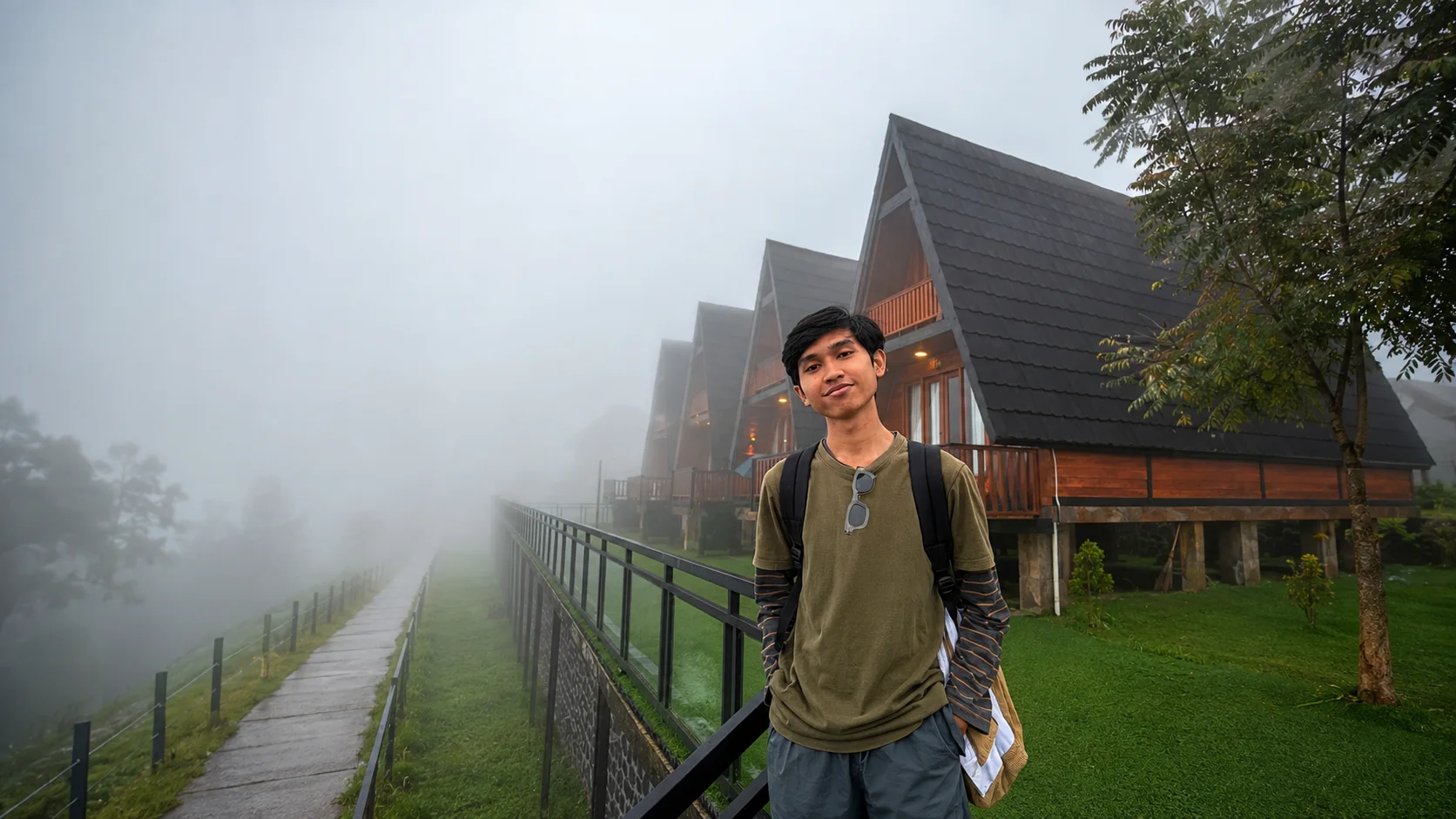
“Initially, it came from the Javanese word ‘emoh,’ which means to refuse. But over time, the word became part of my character. People eventually came to know me by the name Nanang Emoh,” he said.
According to him, a character does not always need to be complex. Simple elements can hold great power when used consistently.
From that single word, Nanang has slowly built his persona, character, and his own narrative world.
A Theater Graduate from ISI Yogyakarta
Behind his humorous demeanor, Nanang possesses a strong foundation in the arts.
He is a graduate of the Theater Arts program at the Indonesian Institute of the Arts (ISI) Yogyakarta.
His experience studying theater influences how he creates content. Nanang is accustomed to studying character development, body gestures, facial expressions, dialogue, and how dramatic situations function before an audience.
“My theater background is certainly very helpful. In theater, I learned about character, expression, gestures, dialogue, and how to build a situation. When creating content, I still use those skills; only the medium is different,” Nanang explained.
While conventional theater has a physical stage, Nanang now brings those performing arts principles to social media.
The camera has become his stage.
Meanwhile, the audience that once sat in front of a stage is now behind the screens of their mobile phones.
The format has also changed. Stories must be packaged faster and more concisely without losing their character or entertainment value.
Simple Humor Turned Absurd
One of the most prominent features of Nanang’s content is how a simple event can turn into an entirely unexpected situation.
He does not always need a complex premise to generate comedy.
Daily conversations, family relationships, love stories, village life, and folklore all find a place in his world.
From there, reality and imagination collide.
“I like to take things that are actually ordinary and develop them into unusual situations. That is usually where the funny part emerges. Sometimes, simple things are easier for the audience to accept,” Nanang revealed.
This approach makes his content feel familiar yet full of surprises.
The audience recognizes the situation, but they cannot always predict where the story will go.
Rice Fields and Villages as More Than Just Backgrounds
Rice fields and rural life are inseparable from Nanang Emoh’s visual identity.
Paddy fields, village paths, simple houses, trees, and lush green environments appear repeatedly in his content.
For Nanang, these locations are not just places to record videos.
The environment is an integral part of the story.
“I don’t feel like I have to use luxurious places to create a story. The village environment, rice fields, roads, or things around us have their own character. I want that simplicity to remain felt in my content,” he said.
This choice also serves as a differentiator when much of digital content often features urban life with modern visuals.
Nanang instead makes the simple environment part of his work's aesthetic.
Featuring Kakang and Cantik
Beyond building the Nanang Emoh persona, he also introduces several characters into his story world.
Among them are the figures of Kakang and Cantik.
These characters appear in various situations—sometimes in romantic stories, parodies, daily life, or tales inspired by folklore.
This is where Nanang’s experience in acting feels particularly strong.
A character is not just created for one video but can be continuously developed and brought into other stories.
Ultimately, the audience recognizes Nanang Emoh not just as a creator, but also begins to know the characters living within his world.
Bringing Folklore to the Digital Generation
Folklore and culture are frequent sources of inspiration for Nanang.
However, rather than presenting them like educational material, he chooses a more relaxed approach.
Stories already known to the public are parodied, developed, or merged with contemporary situations.
“In my opinion, culture and folklore can be presented in many ways. It doesn’t always have to be serious. With humor, the stories can feel lighter and perhaps easier for young people to accept,” said Nanang.
The Javanese language further strengthens this world.
Language does not just function as a tool for communication; it becomes an element that shapes the humor, character, and atmosphere.
The Camera as a New Stage
For Nanang, creating content is not just about recording something funny and uploading it to social media.
There is a performing arts process that continues behind the camera.
It ranges from determining characters and developing stories to choosing dialogue, refining expressions, and deciding how a scene should be played.
“In theater, we have a stage and the audience is directly in front of us; now, the camera is the stage. The principles of storytelling and character acting remain, only the way of delivering them has changed,” he explained.
Social media has ultimately opened up a new performance space.
A character no longer has to wait for a show in a theater building to meet the audience. It can appear at any time through short videos on a phone screen.
Choosing Simplicity
Amidst rapidly changing content trends, Nanang chooses to maintain the elements that have become his identity.
The Javanese language, village life, rice fields, character play, physical expression, and everyday humor remain important parts of his work.
He does not feel he must abandon that simplicity to appear more modern.
On the contrary, that is exactly where the Nanang Emoh character grows.
“I want to keep creating work with my own character. As long as there are stories that can be developed from the life around us, culture, and imagination, I think there is always something that can be told,” Nanang concluded.
Ultimately, Nanang Emoh is a meeting point between theater arts, comedy, Javanese culture, and daily life.
From a simple word, emoh, a persona was born.
From a simple environment, a world of stories was born.
And from the theater stage, Nanang found a new stage that now resides on the screens of millions of social media users.






Comments 1
Write a Comment Share your response