

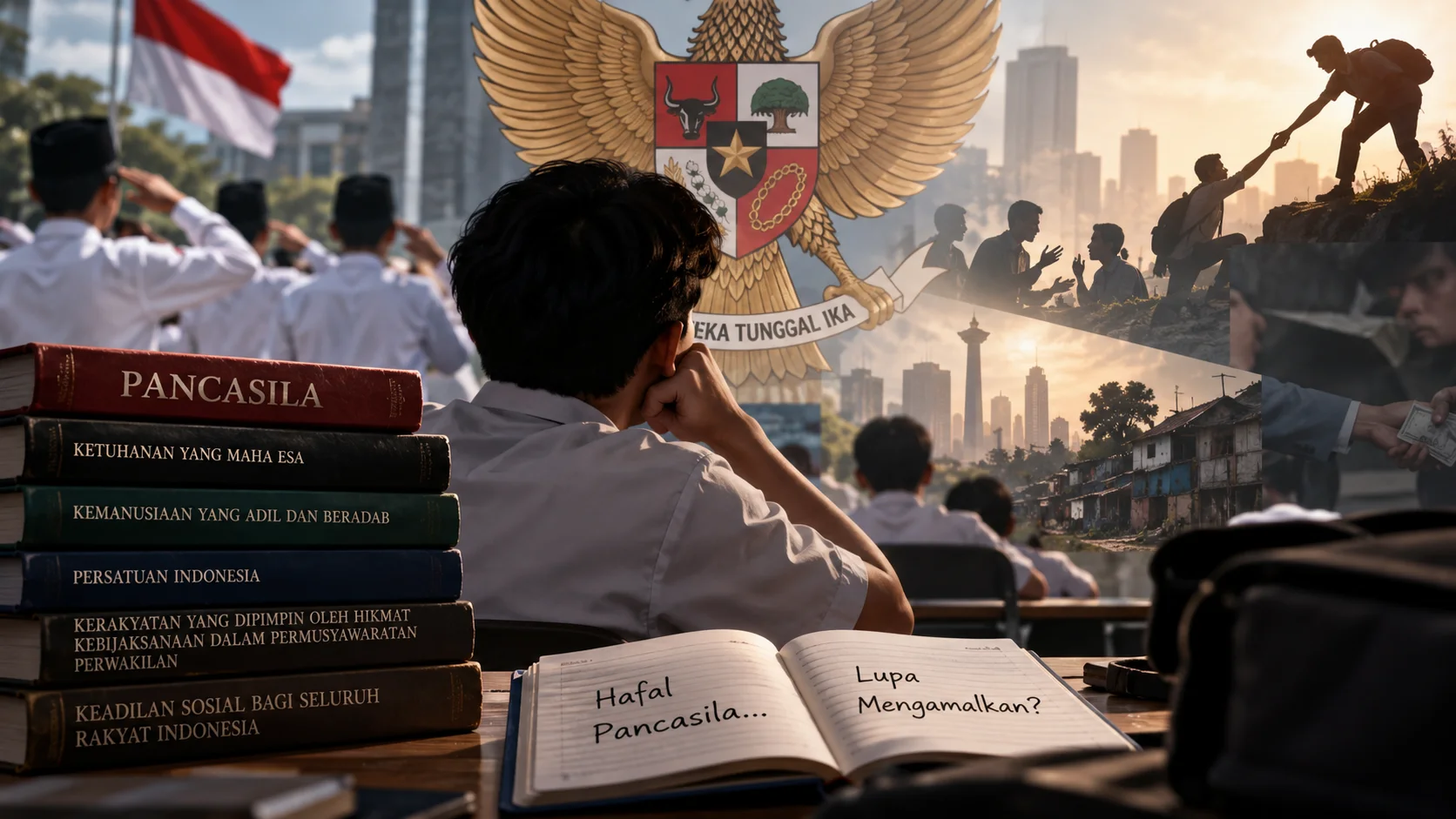
JurnalPost.com In 2023, 83.3 percent of high school students surveyed by the SETARA Institute and INFID stated that Pancasila is not a permanent ideology and could be replaced. The survey involved 947 students across five cities. These students are certainly not unfamiliar with Pancasila; since elementary school, they have been required to learn the five principles, sing national anthems, and stand at attention during flag ceremonies.
This raises an uncomfortable question: if our memorization is so strong, why are our convictions and behaviors not equally robust?
These figures must be interpreted with caution. The survey was conducted in only five cities and cannot be generalized to all Indonesian students. SETARA itself noted that 70.2 percent of respondents are still classified as tolerant.
Nevertheless, the trend is worth noting. Students classified as actively intolerant rose from 2.4 percent in the 2016 survey to 5 percent in 2023, while those exposed to violent extremism increased from 0.3 percent to 0.6 percent. While the absolute numbers are small, both figures have doubled in seven years.
From this, I argue that the main issue with Pancasila today is not a lack of knowledge, but the gap between what we know and what we do. Pancasila is stored in our heads, but it has not yet become a habit.
Knowledge That Stops at the Head
This phenomenon is not limited to high schools. A study of students at Universitas Kahuripan Kediri found that while students' conceptual understanding of Pancasila values was cognitively sound, it had not been fully internalized into their daily behavior (“Strengthening Pancasila Values”, 2025).
This finding will feel familiar to anyone who has taken a course on Pancasila. We know the wording of each principle, can explain the difference between Pancasila as the foundation of the state and as a way of life, and then walk away with a good grade.
Once the exam is over, that knowledge is rarely tested in more difficult settings: long queues, social media comment sections, organizational meetings, or exam rooms where the opportunity to cheat is wide open.
The problem lies in how we treat Pancasila. It is more often taught as material to be remembered rather than values to be lived.
Institutional efforts do exist. The Agency for Pancasila Ideology Education (BPIP), in collaboration with the Ministry of Education, Culture, Research, and Technology, completed the primary Pancasila Education textbooks for elementary and secondary schools in 2023 (Republika, 2024).
However, no matter how good a book is, it does not automatically change behavior. A value only persists when it is seen being practiced by people we respect and when it makes sense in our daily lives.
Five Principles, Five Gaps
The first to third principles: when differences become a test.
Executive Director of the SETARA Institute, Halili Hasani, stated that Pancasila values, especially the first principle, are more often defeated in cases of intolerance and violations of religious freedom, sometimes even by state officials themselves (CNN Indonesia, 2023).
This statement is an assessment by a civil society organization and should be read as one perspective. However, it highlights a clear irony.
The principles regarding divinity, humanity, and unity are all tested at one point: our ability to accept differences. We are fluent in saying “Bhinneka Tunggal Ika” (Unity in Diversity), but we are not necessarily capable of sitting with people who worship differently than we do.
Honesty and justice: an uncomfortable mirror.
In the 2025 Corruption Perception Index (CPI), Indonesia scored 34 and ranked 109th, down from a score of 37 and a 99th-place ranking the previous year (Investortrust.id, 2026).
That score is also below the 40 points achieved in 2019 (Bisnis.com, 2025). The CPI measures perception, not the number of cases, so it should not be read as a final verdict.
However, the Corruption Eradication Commission (KPK) itself has called this decline a call for introspection (Investortrust.id, 2026).
Corruption violates many principles at once. Oaths or promises of office are made before God, but the abuse of power harms the people and erodes social justice.
The fifth principle: good news that is not yet evenly distributed.
Data from the Central Statistics Agency (BPS) shows the poverty rate in September 2025 was 8.25 percent, or 23.36 million people, while the Gini ratio fell to 0.363, 0.012 points lower than in March 2025 (JawaPos.com, 2026).
This is a development that should be acknowledged. However, rural poverty remains at 10.72 percent, far above the urban rate of 6.60 percent (JawaPos.com, 2026).
Social justice cannot be measured solely by average figures. It must be felt by citizens living far from city centers.
The fourth principle in the digital space: author's observation.
The fourth principle teaches deliberation led by wisdom.
In my observation, social media comment sections often move in the opposite direction. We are quicker to reply than to listen, and quicker to judge than to verify.
This is not a survey finding, but a personal reflection that you may also feel. If we are honest, Pancasila on our phone screens does not always look like deliberation.
Why Is Memorization Not Enough?
Memorization trains the memory, whereas behavior is shaped by role models, habits, and consequences. There are at least three reasons why a memorization-based approach is insufficient.
First, values are tested when they have a cost. Being honest when no one is watching or being fair when it disadvantages you are situations not found in multiple-choice questions.
Second, role models are far more convincing than lectures. When young people see elites who invoke Pancasila on stage but violate it behind the scenes, they easily conclude that Pancasila is merely a slogan.
Third, the way we assess learning outcomes often only measures memory, not attitude.
I suspect, without being able to prove it from survey data, that this gap between words and actions is what makes some young people feel that Pancasila does not need to be defended.
This suspicion aligns with SETARA's assessment that the rise in intolerance and exposure to extremism among the younger generation indicates that the grounding and actualization of Pancasila values remain poor (CNN Indonesia, 2023).
In other words, what needs to be improved is not just the subject matter, but the environment they see every day.
From Memorization to Habit
So, what can be done? I offer four realistic steps.
First, role modeling must precede teaching.
Officials, lecturers, teachers, and student organization leaders are the “textbooks” most frequently read by the younger generation. When they are consistent, Pancasila makes sense. When they are inconsistent, a thousand lessons will not help.
Second, learn through experience.
Pancasila education would be more meaningful if it included social projects, interfaith dialogues, and deliberation simulations that address real disagreements, rather than just reading slides and answering quizzes.
Third, start with small things in your own environment.
Not cheating, not skipping class, queuing in an orderly fashion, not spreading unverified news, and listening to differing opinions in discussions are the most tangible exercises in Pancasila.
Honesty in the lecture hall is an initial exercise in fighting corruption in larger spaces.
Fourth, measure behavior, not just memorization.
Schools and campuses can assess achievements through activity portfolios, personal reflections, and projects that impact the surrounding environment.
Conclusion
Pancasila does not lack people who can memorize it. It lacks people who practice it.
Data on rising intolerance among students, declining perceptions of anti-corruption efforts, and the gap between rural and urban areas should not be read as a reason to despair. After all, some indicators, such as poverty and inequality, also show improvement.
However, it serves as a reminder that these five principles will only live if they are practiced, starting from the small things we can do today.
Pancasila does not need to be defended with shouting. It needs to be lived consistently, including when no one is watching.








Comments 0
Write a Comment Share your response