


SOUTH TANGERANG, JurnalPost.com — At the vegetable stalls of Perwira Market in Ciputat, a bag of bird's eye chili serves as a barometer for the average resident's wallet. In early March 2026, the price of red bird's eye chili at the Ciputat market briefly soared to around Rp100,000 per kilogram, well above the reference price of approximately Rp57,000 per kilogram (Komalasari, 2026).
When our team revisited the market in mid-September 2026, traders reported that the price of bird's eye chili had fallen to the range of Rp45,000–Rp60,000 per kilogram (Demand Group 1, 2026).
These price fluctuations shape how the public shops. Consumers have begun to reduce purchase volumes, switch to substitute goods, and seek discounts to align their spending with their economic capacity.
Chili: A Recurring Seasonal Spike
The rise in chili prices in March 2026 coincided with increased demand ahead of Eid al-Fitr. The Deputy Minister of Trade, who inspected the Ciputat market on March 6, 2026, noted price hikes for several staple foods due to the surge in demand before the holiday. During the visit, the government emphasized the importance of maintaining food price stability (detikFinance, 2026).
Nationally, Bank Indonesia, through the Strategic Food Price Information Center (PIHPS), recorded the price of red bird's eye chili at Rp74,750 per kilogram on March 4, 2026 (Kompas TV, 2026).
The Ministry of Agriculture subsequently conducted market operations for chili and shallots from March 10–19, 2026. This step was taken because the average consumer-level price of chili in the first week of March reached Rp71,574 per kilogram, still exceeding the sales reference price (Bisnis.com, 2026).
The chili price issue did not end there. In early October 2026, PIHPS recorded the price of red bird's eye chili at Rp114,000 per kilogram. Meanwhile, the Central Statistics Agency (BPS) warned that the 10.21 percent price increase in the first week of October could potentially put pressure on year-end inflation (Komalasari, 2026).
At the trader level, chili consumers do not fully accept price changes without making adjustments.
According to chili trader Epi Sunandar, consumers with a monthly income of around Rp4 million typically buy 0.5 kilograms of chili per week, with a monthly expenditure of about Rp90,000. When chili prices rise, some consumers choose to switch to bell peppers as a substitute.
Curly red chili trader Arif shared a similar experience. According to him, buyers who usually purchase about one kilogram of chili per week will switch to green chili, priced at Rp15,000–Rp20,000 per kilogram, when the price of curly red chili increases (Demand Group 1, 2026).
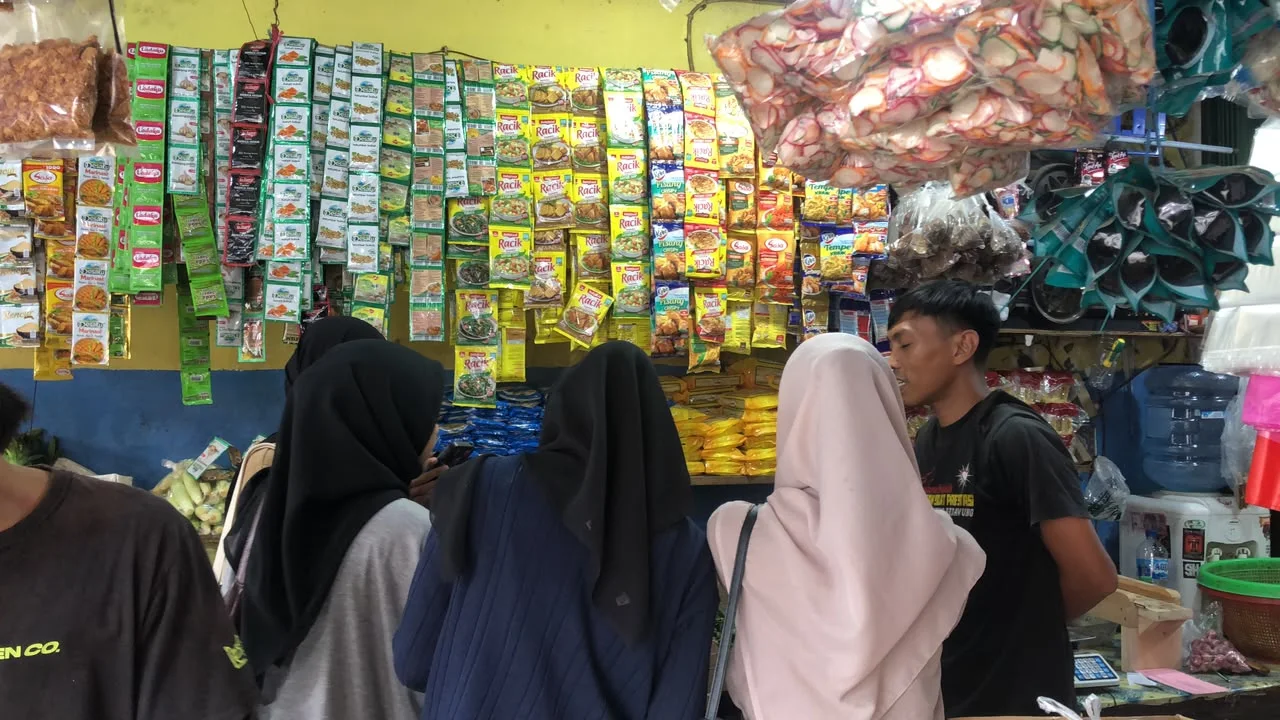
This phenomenon shows that price changes can drive consumers to adjust their purchase quantities or choose substitute goods deemed more affordable.
Chicken: From Eid to the New School Year
The price of broiler chicken at the Ciputat market on March 6, 2026, was reported to have reached Rp45,000 per kilogram, up from the normal price of around Rp40,000 per kilogram (detikFinance, 2026).
A few months later, pressure on chicken prices emerged from a different factor.
The head of BPS stated that the rise in broiler chicken prices in the first week of August 2026 was influenced by limited supply and the resumption of operations at the Nutrition Fulfillment Service Unit (SPPG) kitchens under the Free Nutritious Meal program following the school holidays.
The average national price of broiler chicken at that time reached approximately Rp39,712 per kilogram. If the increase continues, the price has the potential to exceed the reference price (Investortrust, 2026).
In Jambi, the local BPS also linked the rise in chicken prices in July 2026 to the reactivation of SPPG operations, which absorbed the supply of chicken meat (RRI, 2026).
However, the link between the implementation of this program and chicken price changes at Perwira Market in Ciputat has not been supported by specific data.
Interviews with traders show that consumers tend to make adjustments when chicken prices rise.
Chicken trader Abdul Kholik explained that the current price of chicken is in the range of Rp40,000–Rp45,000 per bird, compared to the normal price of around Rp30,000–Rp35,000 per bird.
When chicken prices rise, some buyers choose to switch to chicken liver and gizzard, which are sold for Rp25,000–Rp30,000.

A similar pattern was found for fish commodities.
Fish trader Sakur stated that the price of fresh carp is in the range of Rp25,000–Rp50,000 per kilogram, depending on the size. When the price of carp increases, some consumers choose tilapia as an alternative (Demand Group 1, 2026).
These changes demonstrate how consumers consider substitute goods to maintain household consumption when price increases occur.
Fruit: Imported Grapes Remain in Demand
In the fruit commodity sector, traditional markets also face demand dynamics influenced by the presence of imported products.
BPS recorded that Indonesia imported approximately 932.7 thousand tons of fruit valued at US$2.02 billion in 2025. This figure is an increase compared to 2024, when fruit imports reached 780.5 thousand tons valued at US$1.66 billion (GoodStats, n.d.).
Based on observations at Perwira Market in Ciputat, there is a difference in demand between imported fruits with relatively high prices and more affordable fruits.
At Pakde's Fruit Shop, imported red grapes are sold for Rp90,000–Rp100,000 per kilogram. The trader mentioned that the number of buyers is around 5–7 people per day, with a stock of about 20–25 kilograms per week.
Meanwhile, Mba Alika's shop sells oranges for Rp25,000–Rp30,000 per kilogram. The number of buyers is around 10–15 people per day, with a stock of about 30–35 kilograms per week (Demand Group 1, 2026).
This price difference affects household budget considerations.
For example, a consumer with an income of around Rp5 million per month who buys one kilogram of grapes every week will spend Rp360,000–Rp400,000 per month.
This amount is equivalent to about 7–8 percent of monthly income, based on the team's calculations using interview data.
When the price of grapes is considered too expensive, some consumers choose to switch to apples, which are sold for Rp50,000–Rp70,000 per kilogram.
Meanwhile, orange buyers also consider snake fruit as a substitute, priced at around Rp10,000 per kilogram (Demand Group 1, 2026).
These findings illustrate how price differences and the availability of substitute goods become considerations in purchasing decisions for fruit.
Wholesale Discounts Are Slim, Haggling Continues
Haggling remains a part of transaction activities at Perwira Market in Ciputat.
Based on information from traders, purchases in larger quantities generally receive discounts, although the percentage is relatively small.
For oranges, a three-kilogram purchase that was originally Rp54,000 can receive a discount to around Rp50,000.
For grapes, a three-kilogram purchase with an initial price of Rp270,000 receives a discount of Rp10,000, bringing the total price to Rp260,000.
Similar discounts are also given for chili commodities.
A three-kilogram purchase of bird's eye chili that was originally Rp135,000 can receive a discount to Rp125,000.
Meanwhile, a four-kilogram purchase of curly red chili that was originally Rp120,000 can drop to Rp110,000.
For chicken, a seven-kilogram purchase with an initial price of Rp315,000 can receive a discount to around Rp310,000 (Demand Group 1, 2026).
Based on the team's calculations, the amount of these price discounts ranges from about 1.6 percent for chicken to about 8 percent for curly red chili.
This shows that traders strive to maintain profit margins while providing incentives for consumers to make larger purchases.
Elastic or Not?
In microeconomics, price elasticity of demand describes the sensitivity of the quantity of goods demanded to price changes.
Demand is called elastic if the percentage change in the quantity of goods demanded is greater than the percentage change in price. Conversely, demand is called inelastic if the percentage change in the quantity of goods demanded is smaller than the percentage change in price.
Based on interviews, traders assess that the demand for bird's eye chili, curly red chili, chicken, and carp tends to be inelastic because these commodities are needed for daily consumption.
Meanwhile, the demand for oranges and grapes is considered more elastic because both are not staple needs and are relatively easy to replace with other types of fruit (Demand Group 1, 2026).
However, this assessment is still based on the experience and observations of traders, not on quantitative calculations of elasticity coefficients.
Therefore, data on prices and sales volumes over a longer period are needed to prove the level of elasticity of each commodity more accurately.
What Can Be Done?
Observations at Perwira Market in Ciputat show three main patterns that influence consumer demand: seasonal demand spikes, supply dependence on central markets, and the tendency of consumers to switch to substitute goods when prices rise.
Market operations carried out by the government during Ramadan showed an effort to dampen food price pressure (Bisnis.com, 2026).
However, daily price monitoring and the strengthening of early warning systems ahead of major religious holidays or the start of the school year need to be considered so that price control policies are not merely reactive.
For traders, building relationships with more than one supplier can be a strategy to reduce the risk of supply shortages.
In addition, inventory planning before peak demand periods can help traders maintain the availability of goods while anticipating price changes.
Meanwhile, for consumers, understanding substitute goods can help adjust household spending.
Options such as bell peppers, green chili, liver and gizzard, or tilapia can be alternatives when the prices of main commodities rise, while still considering consumption needs and preferences.
Thus, price changes not only affect the quantity of goods demanded but also encourage consumers and traders to make adjustments in economic activities.
These observations show that the concepts of demand, price elasticity, and substitute goods in microeconomics can be found directly in buying and selling activities in traditional markets.
Methodological Note: Data on prices and buyer behavior were obtained through interviews with traders at Perwira Market in Ciputat in mid-September 2026. Supporting data comes from news reports and publications of official institutions as listed in the bibliography.
Bibliography
Bisnis.com. (2026, March 9). Chili prices remain high, Ministry of Agriculture prepares market operations at 20 points in Jakarta. https://ekonomi.bisnis.com/read/20260309/12/1958923/harga-cabai-masih-tinggi-kementan-siapkan-operasi-pasar-di-20-titik-jakarta
detikFinance. (2026, March 6). Results of Deputy Minister of Trade's tour of Ciputat Market: Chili, chicken, egg prices rise. https://finance.detik.com/berita-ekonomi-bisnis/d-8387130/hasil-wamendag-keliling-pasar-ciputat-harga-cabai-ayam-telur-naik/amp
GoodStats. (n.d.). 10 largest fruit importing countries to Indonesia 2025 [Data sourced from BPS, Indonesia Statistics 2026]. https://data.goodstats.id/statistic/10-negara-pengimpor-buah-terbesar-ke-indonesia-2025-Cr3MK
Investortrust. (2026, August). MBG kitchen resumes operations, chicken meat prices rise in 188 regencies/cities. https://investortrust.id/macro/112344/dapur-mbg-kembali-beroperasi-harga-daging-ayam-naik-di-188-kabupatenkota
Demand Group 1. (2026, September 15). Market demand analysis [Class presentation; trader interview data from Perwira Market Ciputat]. UIN Syarif Hidayatullah Jakarta.
Kompas TV. (2026, March 4). Food price update Wednesday, March 4, 2026: Red bird's eye chili hits Rp74,750 per kg. https://www.kompas.tv/nasional/654479/update-harga-pangan-rabu-4-maret-2026-cabai-rawit-merah-tembus-rp74-750-per-kg
Komalasari, T. D. (2026, October 6). Bird's eye chili prices get spicier, reaching Rp114 thousand per kg, risk of contributing to inflation. Katadata. https://katadata.co.id/berita/industri/6ac46927d0b19/harga-cabai-rawit-makin-pedas-capai-rp114-ribu-per-kg-risiko-sumbang-inflasi
RRI. (2026, August 3). School nutrition program begins, chicken meat prices in Jambi increase. https://rri.co.id/jambi/regional/2623728/program-gizi-sekolah-dimulai-harga-daging-ayam-di-jambi-meningkat



Comments 0
Write a Comment Share your response