

JurnalPost.com - The issue of sexual harassment has long been a concern for society, both in Indonesia and across various nations. Sexual violence can manifest in many forms, ranging from verbal harassment and unwanted actions to coercion and threats against the survivor (Harahap & Safiq, 2026).
Unfortunately, the suffering of survivors does not always end after the incident occurs. When such cases become public, survivors often face accusations, judgment, and negative comments that effectively place the burden of responsibility on them rather than the perpetrator.
This phenomenon is known as victim blaming, which is the act of holding survivors responsible for the violence or harassment they have endured. In victimology, this condition is linked to secondary victimization—the additional suffering experienced by survivors due to negative responses from their social environment, the public, or institutions that should provide protection (Harahap & Safiq, 2026).
The culture of blaming the victim does not emerge in a vacuum. One contributing factor is the prevalence of patriarchal culture, which often dictates that women are responsible for their own behavior and safety, even when they are victims of sexual violence.
Furthermore, a lack of public understanding regarding sexual violence reinforces views that marginalize survivors. Many people still associate harassment with a survivor's clothing, lifestyle, or social activities, rather than placing the responsibility squarely on the perpetrator.
The rise of social media has further expanded the space for victim blaming. Viral cases of sexual harassment are frequently met with negative comments, ranging from questioning the survivor's attire to trivializing their experience of violence.
Such social pressure has the potential to worsen the survivor's psychological state. Research by Shoib et al. (2022) on childhood sexual abuse experiences also highlights the critical need to address the link between sexual violence trauma and the risk of suicidal behavior.
In Indonesia, protection for survivors is technically regulated through several laws, including the Law on the Protection of Witnesses and Victims and the Law on the Crime of Sexual Violence (UU TPKS). However, implementation still faces challenges, primarily due to social stigma, gender bias, and a lack of avictim-oriented approach.
Several studies have highlighted the importance of social understanding, critical awareness, and standing with survivors in handling sexual violence (Drewett et al., 2021; Jayapalan et al., 2018; Fitri et al., 2021).
Thus, victim blaming is not merely an issue of individual attitude, but a social phenomenon deeply connected to culture, communication, and gender constructs within society.
Forms of Victim Blaming on Social Media
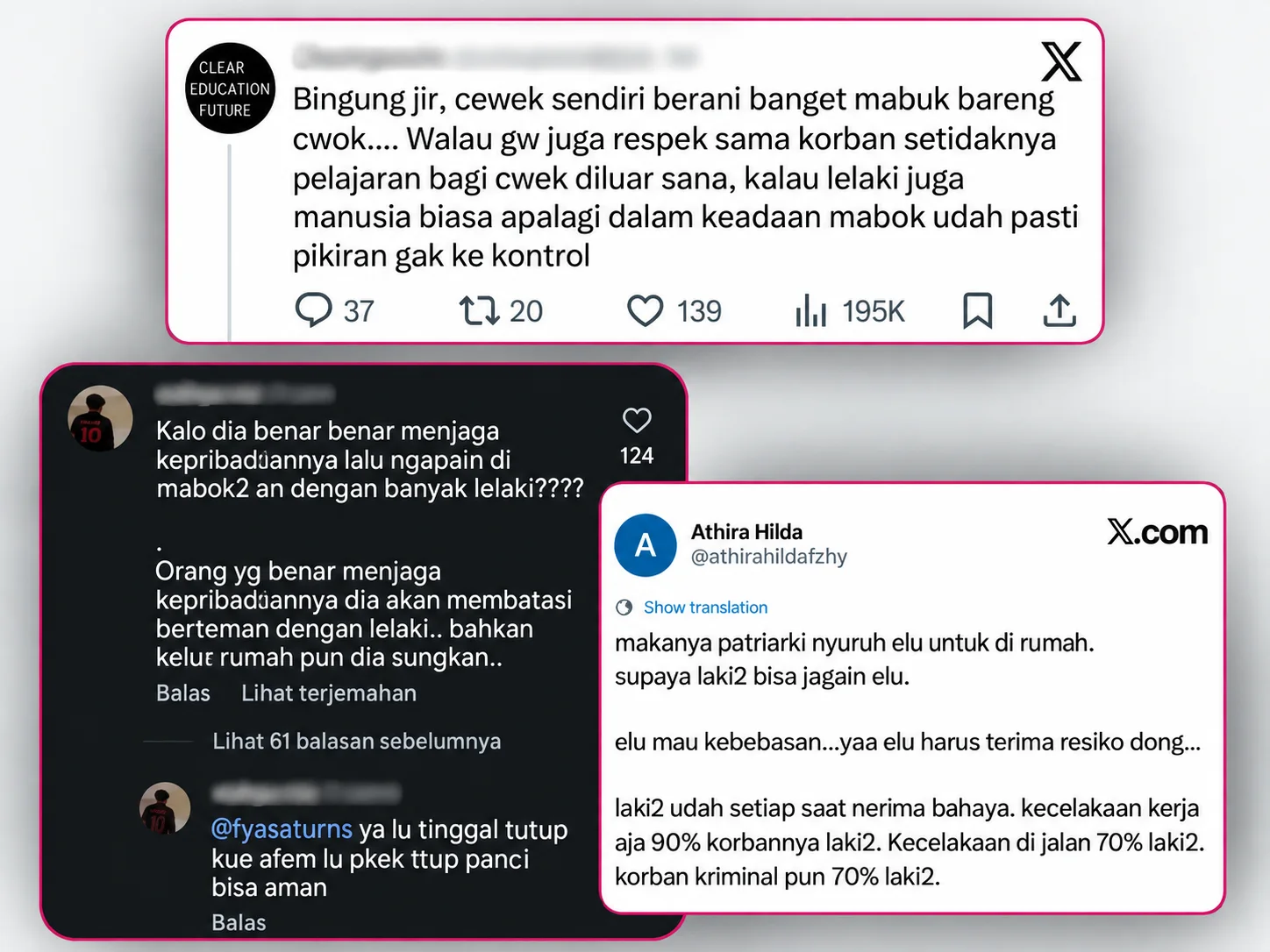
The phenomenon of victim blaming can be observed through various comments from netizens on social media, such as on the platform X (formerly Twitter).
These comments demonstrate how some members of society still view sexual harassment survivors through a lens that blames, demeans, or questions the survivor's behavior.
One such comment read:
“That is why patriarchy tells you to stay at home so men 2 can protect you. You want freedom... well, you have to accept the risks... men 2 face danger every day; 90% of workplace accident victims are men 2. 70% of road accident victims are men 2, and 70% of crime victims are men 2”.
This comment illustrates a form of victim blaming through the justification of patriarchal culture. Women's freedom is linked to the risk of violence, which is framed as a necessary consequence of their choices.
Additionally, the comment diverts the discussion by citing statistical claims regarding risks faced by men. Regardless of the accuracy of these figures, using such comparisons obscures the core issue: the sexual violence experienced by the survivor.
Narratives like this are linked to the validation of patriarchal values and the normalization of sexual violence, as discussed by Nurbayani and Wahyuni (2023).
Another form is seen in the following comment:
“I’m confused, why would a woman be brave enough to get drunk with men... Even though I respect the victim, at least this is a lesson for women out there, that men are just ordinary humans, especially when drunk, their minds are definitely not in control”.
This comment reflects judgment toward the survivor's lifestyle and activities. The focus is shifted to the survivor's decision to consume alcohol or be in the company of men.
The statement also tends to excuse the perpetrator's behavior due to the influence of alcohol. In reality, intoxication cannot be used to justify harassment or sexual violence.
In this context, the survivor is seemingly held responsible for being in a certain situation, while the perpetrator's actions are granted a degree of justification.
According to Nurbayani and Wahyuni (2023), such normalization narratives are part of a cultural issue that sustains the practice of blaming sexual violence survivors.
Moral Judgment and the Objectification of Women's Bodies
The next form of victim blaming is seen in comments that link the experience of sexual harassment to a woman's morality and behavior.
One comment read:
“If she really guarded her virginity, then why was she getting drunk 2 with many men??? Someone who truly guards her virginity would limit her friendships with men... she would even be hesitant to leave the house....”
This comment demonstrates moral judgment toward the survivor. Women are evaluated based on specific views regarding virginity, social circles, and boundaries in public spaces.
This perspective potentially creates the assumption that women who do not meet certain moral standards are to be blamed when they experience sexual harassment.
In reality, a person's right to be free from sexual violence does not depend on their clothing, social activities, or personal decisions.
This judgment is further highlighted when the same account responded to a rebuttal from a female netizen with the comment:
“well, you just need to cover your private parts with a pot lid so you're safe”.
This comment can be analyzed through three forms of victim blaming and verbal abuse.
1. Sexual objectification and verbal harassment
The use of the term "kue afem" in the comment refers disparagingly to female genitalia.
This expression is a form of sexual objectification because it reduces the female body to an object that can be mocked.
Comments like this not only degrade the dignity of women but also show how language is used to maintain views that disrespect the survivor's body and experience.
2. Blaming the survivor through sarcasm
The phrase "cover with a pot lid" uses a sarcastic analogy to shift the responsibility for preventing sexual harassment onto women.
Through this comment, women are seemingly obligated to take various preventive measures to avoid becoming victims.
This view is problematic because it shifts the focus from the perpetrator's actions to the survivor's behavior. In reality, the primary responsibility for sexual harassment remains with the person who commits the act.
3. Blaming the survivor's clothing and body
Indirectly, the comment also implies that women must cover their bodies to avoid sexual harassment.
Such a view can reinforce the false assumption that harassment occurs due to the survivor's clothing or appearance.
In fact, sexual harassment is an act related to the violation of boundaries, consent, and a person's right to bodily safety.
These three types of comments show how victim blaming can be conveyed through language disguised as jokes, advice, or moral criticism. However, the underlying message still has the potential to reinforce stigma against survivors (Nurbayani & Wahyuni, 2023).
The Importance of Changing Perspectives on Survivors
Based on these examples, it is clear that the phenomenon of victim blaming against sexual harassment survivors is not just a matter of interpersonal communication, but is also linked to social constructs deeply rooted in society.
Patriarchal culture, moral judgment, low literacy regarding sexual violence, and the use of social media without considering its impact are factors that reinforce the practice of blaming survivors.
As a result, survivors may experience secondary victimization, including social pressure, shame, fear of speaking out, and deteriorating mental health.
Therefore, a shift in how society responds to sexual harassment cases is necessary. Attention should be directed toward the perpetrator's actions, the protection of survivor rights, and the recovery process, rather than attempting to find fault in the survivor's personal life.
Education on gender equality, empathetic communication, and an understanding of sexual violence must be continuously strengthened within families, educational institutions, and digital spaces.
Society also needs to be more cautious when commenting on sexual violence cases on social media. Every statement made can affect a survivor's psychological state, especially when the comment contains judgment or verbal abuse.
Ultimately, ending the culture of victim blaming is part of the effort to create a safer and more just social environment.
It is time for society to stop acting as a judge of survivors' lives and start providing space for them to receive protection, support, and justice.
Survivors need recovery and solidarity, not judgment. The responsibility for sexual harassment remains with the perpetrator, not the person who experienced it.
References
Drewett, C., Oxlad, M., & Augoustinos, M. (2021). Breaking the silence on sexual harassment and assault: An analysis of #MeToo tweets. Computers in Human Behavior, 123.
Fitri, A., Haekal, M., Almukarramah, A., & Sari, F. M. (2021). Sexual violence in Indonesian University: On students’ critical consciousness and agency. Gender Equality: International Journal of Child and Gender Studies, 7(2), 153–167.
Harahap, T. A. A., & Safiq, A. (2026). Victim Blaming dalam Kasus Kekerasan Seksual: Telaah Viktimologi dan Perlindungan Korban. Fatih: Journal of Contemporary Research, 3(1), 261–276.
Jayapalan, A., Wong, L. P., & Aghamohammadi, N. (2018). A qualitative study to explore understanding and perception of sexual abuse among undergraduate students of different ethnicities. Women’s Studies International Forum, 69, 26–32.
Nurbayani, S., & Wahyuni, S. (2023). Victim Blaming in Rape Culture: Narasi Pemakluman Kekerasan Seksual di Lingkungan Kampus. Malang: Unisma Press.
Shoib, S., Amanda, T. W., Saeed, F., Armiya’u, A. Y., Patel, V., Chandradasa, M., & De Berardis, D. (2022). Relationship between childhood sexual abuse and suicidal behaviour in South Asian countries: A scoping review. Psychiatry Research Communications, 2(3).







Comments 0
Write a Comment Share your response