

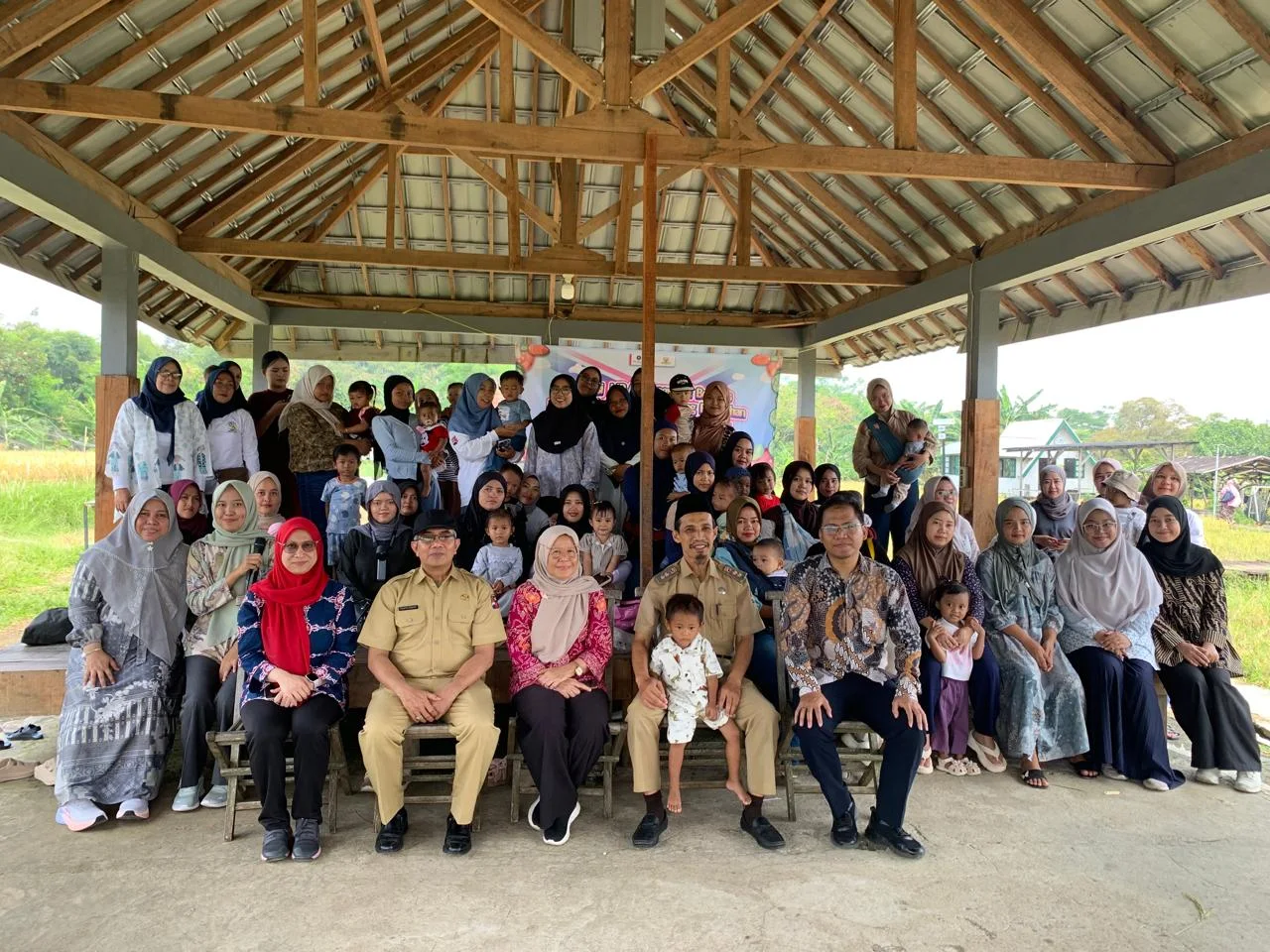
BOGOR, JurnalPost.com - The IPB University Vocational School, through its Food and Nutrition Industry Management Study Program, held a community service event at Saung AEWO, Mulyaharja Village, Bogor City, on Tuesday (20/10/2026). This activity is part of an effort to raise public awareness regarding the importance of monitoring toddler growth as an early step in preventing stunting.
Through nutrition counseling and weight and height measurement services, parents were provided with an understanding of how to properly monitor their children's growth and development. The activity was attended by 30 mothers of toddlers and six local posyandu (integrated healthcare center) cadres.
The event was opened by the Vice Dean for Academic and Student Affairs of the IPB University Vocational School, Dr. Ir. Rina Martini, M.Si. In her remarks, she emphasized the importance of routine child growth monitoring so that growth disorders can be identified early.
“Although simple, monthly weighing is important because it is one of the easiest ways to monitor a child's growth,” said Rina.
According to her, growth monitoring is not just about recording weight figures, but also serves as a basis for determining whether a child's development is appropriate for their age.
Mulyaharja Village Secretary, Taufik Hidayat, S.A.P., who also attended the event, expressed his appreciation for the contribution of IPB University academics in providing health education to the community.
The collaboration between the university, the village government, and posyandu cadres is expected to strengthen efforts to prevent nutritional issues through an educational approach that directly addresses the needs of families.
Introducing the 3T Philosophy for Toddler Nutrition Monitoring
The counseling session featured two speakers from the IPB University Vocational School, Annisa Rizkiriani, S.Gz., M.Si., and Rosyda Dianah, S.K.M., M.K.M.
Both presented material on monitoring toddler nutritional status by adapting the 2024 Maternal and Child Health (KIA) Handbook through the 3T approach: Tepat Cara (Correct Method), Tepat Catat (Correct Recording), and Tindak Lanjut (Follow-up).
On the principle of Correct Method, participants were introduced to standard anthropometric measurement procedures. Weight and length or height measurements must use standardized tools and be performed with correct techniques to ensure accuracy.
During weighing, children are advised not to wear footwear and to wear minimal clothing. Meanwhile, length or height measurements are taken by paying attention to body position and using tools appropriate for the child's age.
Next, the principle of Correct Recording emphasizes the importance of recording measurement results periodically on growth charts in the KIA Handbook, including the Health Card (KMS).
This recording helps parents and posyandu cadres observe weight gain patterns over time, while also identifying signs of growth disorders that require further attention.
As for the principle of Follow-up , it teaches participants not to ignore measurement results that indicate suboptimal growth.
If a child's growth chart tends to flatten or decline, parents need to evaluate feeding patterns, the possibility of infectious diseases, and other factors that may affect the child's nutritional condition. Further examination at a health facility is necessary if signs of growth disorders are found.
Through this approach, parents are expected not only to visit the posyandu regularly but also to understand the meaning of the measurement results and the steps to take afterward.
Interactive Discussion on Child Nutrition Issues
In addition to receiving counseling material, participants had the opportunity to consult directly with the speakers regarding various issues they face in caring for toddlers.
One question that arose concerned children who are active and have a good appetite, but whose weight is difficult to increase.
In discussing this case, the speakers explained that a history of recurrent infections, including digestive disorders such as gastroenteritis, can affect nutrient absorption and child growth.
Another issue discussed was the practice of providing complementary foods (MP-ASI) before the baby is six months old. This condition is partly related to the influence of family care habits, even though posyandu cadres have provided education on the importance of exclusive breastfeeding.
The discussion also touched on the case of a five-month-old baby weighing 10 kilograms, while their birth weight was recorded at 3 kilograms.
The speakers reminded the audience of the importance of evaluating nutritional status using growth standards appropriate for the child's age and gender. Weight alone is not enough to diagnose overweight or obesity.
Parents were also given guidance on the importance of maintaining exclusive breastfeeding until the age of six months, providing motor development stimulation according to age stages, and monitoring child growth through health workers.
These various questions show that toddler nutrition issues are not only related to food availability but are also influenced by parental knowledge, care patterns, and the child's health condition.
To create a more comfortable atmosphere, the service team also provided coloring materials themed around nutritional status monitoring at the posyandu for children who attended with their parents.
Mulyaharja Village Head Reminds of the Importance of Nutritious Local Food
Closing the series of activities, the Mulyaharja Village Head, Muslim Yuliantono, S.Sos., M.Si., expressed his appreciation for the implementation of the community service program conducted by the IPB University Vocational School.
He believes that education on child nutrition is important to strengthen family food security while building awareness that meeting nutritional needs does not always require expensive food ingredients.
“Nutritious food can be obtained from local sources; it does not have to be expensive. Do not differentiate between boys and girls; everyone must receive nutritious food,” emphasized Muslim.
He also invited parents to apply the knowledge they have gained in their daily lives, including ensuring that every child receives nutritious food intake fairly and according to their needs.
According to him, the success of stunting prevention efforts requires the involvement of all parties, ranging from families, posyandu cadres, health workers, and the government, to academics.
Through this activity, the IPB University Vocational School hopes that knowledge regarding toddler growth monitoring can be applied sustainably by the Mulyaharja community.
Participants are also expected to share the information obtained with their families and the surrounding environment so that awareness of the importance of monitoring child nutritional status continues to increase.
This collaboration is a form of contribution from the university in supporting stunting prevention efforts while encouraging the formation of a healthier generation through the strengthening of nutrition education at the family level.





Comments 0
Write a Comment Share your response