


Bogor, JurnalPost.com — Fruit peels and vegetable scraps that are typically discarded can actually be repurposed into fermented products. Through simple processing, organic household waste can be transformed into eco-enzyme, serving as a first step toward reducing the volume of daily waste.
This utilization of organic waste was introduced by faculty and students from the Environmental Engineering and Management Study Program at the Vocational School of IPB University to the residents of Mulyaharja Village, South Bogor District, Bogor City.
The educational session and practical workshop on making eco-enzyme were held on Saturday, 26 September 2026, at the Ar Rohman Madrasah, RT 003/RW 008, Mulyaharja Village, from 10.00 to 12.30 WIB.
More than 20 residents from RW 008 and RW 009 attended the event. Also present were RW 008 Head Lia Sukmadi and Mulyaharja Village Secretary Taufik Hidayat.
Through this community service activity, residents were encouraged to understand that waste management does not always have to begin at large-scale facilities. Simple steps taken in the household kitchen can also contribute to reducing waste accumulation.
Understanding Eco-Enzymes and the Benefits of Organic Waste Processing
In daily life, food scraps such as fruit peels and vegetable trimmings often end up in the trash. However, much of this waste can be repurposed if it is separated and handled correctly.
One method introduced to the Mulyaharja residents was the production of eco-enzyme.
Eco-enzyme is a liquid resulting from the fermentation of organic materials, such as fruit peels and vegetables, mixed with sugar or molasses and water.
This process utilizes organic materials previously considered useless, turning them into a fermented product that can be used for various purposes, depending on its characteristics and safety guidelines.
Beyond adding value to household scraps, making eco-enzymes serves as a learning tool for the community regarding the importance of sorting waste at the source.
The material for this activity was presented by Dr. Yudith Vega Paramitadevi, S.T., M.Si., who explained the definition of eco-enzymes, the necessary ingredients, fermentation stages, and important considerations during the production process.
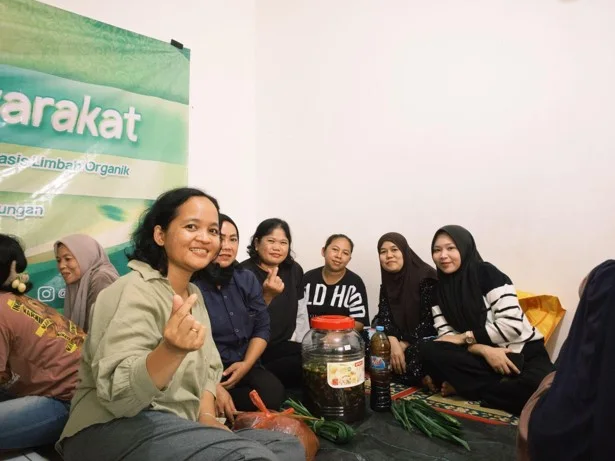
Participants not only listened to the presentation but also had the opportunity to try mixing the ingredients themselves under the guidance of faculty and students.
Through this approach, it is hoped that the community will more easily grasp organic waste processing methods and be able to practice them at home.
Residents Learn to Make Eco-Enzymes Hands-On
During the practical session, participants were introduced to the composition of ingredients used to make eco-enzymes.
Based on the training materials, the ratio of ingredients used is 10 part water, 1 part molasses, and 3 parts organic waste.
For example, for a plastic container with a capacity of 10 liters, participants were shown how to use 6 liters of water, 600 grams of molasses, and 1,800 grams of fruit peels and vegetables.
The organic materials are prepared before being mixed with water and molasses in a screw-top plastic container.
The mixture then undergoes a fermentation process.
In the initial stage, fermentation can produce gas, so the container must be checked and the gas pressure released periodically and carefully according to the instructor's guidance. The container should also have space for the gas that forms and should not be filled to the brim.
Participants received explanations regarding these steps to ensure the fermentation process proceeds correctly and to avoid risks associated with pressure buildup in the container.
The practical session was a crucial part of the training, as participants could see the ingredients used, the mixing process, and the preparation for storage during fermentation.
IPB University faculty and students assisted residents throughout the activity, including providing explanations when participants asked questions about the stages of organic waste processing.
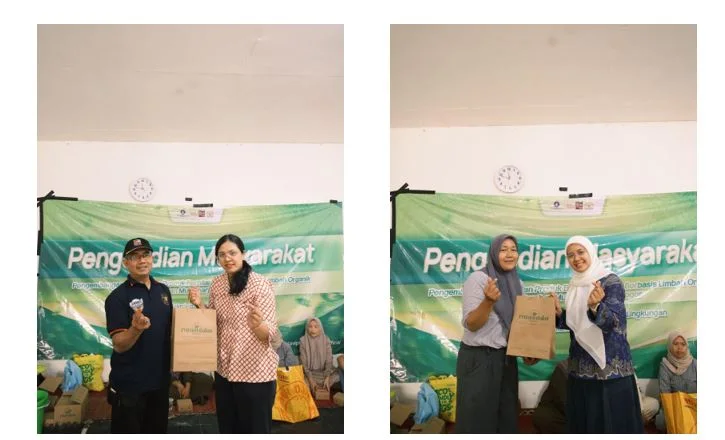
This hands-on approach is expected to help the community apply the knowledge gained without needing complex equipment.
Mulyaharja Residents Respond Positively to Training
The educational activity on organic waste processing received a positive response from the local community.
RW 008 Head, Lia Sukmadi, expressed her appreciation to the faculty and students of the IPB University Environmental Engineering and Management program for sharing their knowledge on utilizing household waste.
“Thank you to the lecturers and students of IPB University's Environmental Engineering and Management program for their visit and the knowledge shared. We as residents are very happy to learn this directly, and we will apply this knowledge in our daily lives,” she said.
According to Lia, the opportunity to learn about waste processing firsthand was a valuable experience for the residents, especially for application in their daily activities.
Similar appreciation was expressed by Mulyaharja Village Secretary, Taufik Hidayat.
He hopes that the knowledge gained by the participants will not end with the training but will be applied sustainably in their households.
“Thank you to the lecturers and students of IPB University's Environmental Engineering and Management program for the knowledge provided. Hopefully, the participants can understand what has been taught and implement it in their daily lives,” he said.
Meanwhile, the Head of the Environmental Engineering and Management Study Program at the Vocational School of IPB University, Dr. Ir. Beata Ratnawati, S.T., M.Si., expressed her gratitude to the Mulyaharja community for welcoming the service activity.
“Thank you for allowing us to share this knowledge. We hope that what we have provided can be useful for your environment, especially in utilizing organic waste and reducing waste at its source,” she stated.
Faculty and Students Involved in Mentoring
This eco-enzyme training is part of a community service activity carried out by the Environmental Engineering and Management Study Program, Vocational School, IPB University.
The activity was led by Faradillah Raynita Yusuf, S.T., M.T., as the project manager.
Several other lecturers were involved, namely Dr. Ir. Beata Ratnawati, S.T., M.Si.; Wiranda Intan Suri, S.T., M.T.; Dimas Ardi Prasetya, S.T., M.Si.; Andini Tribuana Tunggadewi, S.E., M.Si.; Luvy Dellarosa, S.T., M.T.; Dr. Yudith Vega Paramitadevi, S.T., M.Si.; Miesriany Hidiya, S.T.P., M.Si.; Ir. Nurul Jannah, M.M., Ph.D.; Dr. Emil Wahdi, S.Si., M.Si.; and Septian Fauzi Dwi Saputra, S.T.P., M.Si., Ph.D.
In addition to the lecturers, 10 Environmental Engineering and Management students also took part in the activity.
They are Afief de Shafwan, Dean Nabil Alvaro, Muhammad Matin Nazzala, Muhammad Yahya Wijaya, Naila Azizah Fitrianisa, Sri Lintang Mustafa, Tomy Pamungkas Wicaksono, Vina Melinda, Yudiza Salwa Salsabila, and Zulika Gina Khayira.
The students assisted with various logistical needs for the event and guided participants during the eco-enzyme production practice.
Student involvement provided an opportunity to apply the knowledge gained during their studies in activities directly related to the community.
Waste Management Starts at Home
The issue of household waste cannot be solved solely by transporting it to a final disposal site. Efforts to reduce waste must also be made from the moment the waste is generated.
Sorting and processing organic waste is one step that the community can take to reduce the amount of waste discarded.
Through this training, Mulyaharja residents were introduced to an alternative use for fruit peels and vegetables that may not have been widely practiced in their daily lives before.
However, making eco-enzymes is not the only method of organic waste processing. The community can also utilize other methods, such as composting, depending on the type of waste and their individual needs.
The most important thing is to build the habit of sorting and reducing waste consistently.
Educational activities accompanied by hands-on practice are expected to be a starting point for the community to implement independent waste processing in their households.
By involving residents, faculty, and students, this service activity also demonstrates how knowledge from universities can be applied to address problems faced by the community.
Ultimately, efforts to reduce waste do not always require major steps.
Simple habits such as separating fruit and vegetable scraps, learning how to process them, and reusing materials that still have value can be part of a broader change.
From the household kitchens in Mulyaharja, small steps in managing waste are expected to continue to grow into habits that support a cleaner environment and sustainable waste management.








Comments 0
Write a Comment Share your response