


BATU, JurnalPost.com – Accounting students from the State Islamic University (UIN) Sunan Ampel Surabaya, members of Group 9, conducted a field study (KKL) in Oro-Oro Ombo Village, Batu City, East Java, on Tuesday (6/10/2026).
This activity provided an opportunity for students to learn firsthand about village financial governance, the development of Village-Owned Enterprises (BUM Desa), and the utilization of tourism potential to support the local economy.
Under the guidance of lecturer Abdullah Kafabih, M.SE., the students not only received theoretical presentations but also visited several business units to observe how accounting concepts and business management are applied in village economic activities.
The series of activities began with the group's departure at 06.30 WIB. The students arrived in Oro-Oro Ombo Village around 09.30 WIB and attended an opening ceremony attended by study program representatives and village officials.
The event also included the signing of a Memorandum of Understanding or Memorandum of Understanding (MoU) between the Accounting Study Program of UIN Sunan Ampel Surabaya and the Oro-Oro Ombo Village Government.
Understanding the Economic Development of Oro-Oro Ombo Village
The Head of Oro-Oro Ombo Village, Wiweko, served as the first speaker, explaining the village's development journey toward becoming a tourism-based economic hub.
In his presentation, Wiweko noted that Oro-Oro Ombo has experienced significant growth. The village, which was still classified as underdeveloped in 2008, successfully achieved independent village status by 2021.
Furthermore, in 2022, Oro-Oro Ombo reportedly achieved the top national ranking in the Village Development Index (IDM).
With a land area of approximately 13.9 square kilometers and a population of 12,026 people, Oro-Oro Ombo possesses economic potential closely linked to the tourism sector development of Batu City.
This development is supported by partnerships with several companies, including PT Mutiara Indah Sejahtera, which manages the Batu Night Spectacular (BNS), PT Siner Internasional through Batu Love Garden (Baloga), and PT Jaya Giri Panderman, which is involved in the development of Jatim Park.
In addition to establishing partnerships with business entities, the village government has also developed the Oro-Oro Ombo 1000 Homestay program as an effort to expand community involvement in the tourism sector.
Wiweko also emphasized the importance of transparency and accountability in decision-making, including through village deliberations with the Village Consultative Body (BPD).
Regarding the budget, the Oro-Oro Ombo Village Revenue and Expenditure Budget (APBDes) increased from Rp7.22 billion in 2020 to Rp12.385 billion in 2025. This growth was also accompanied by an increase in Original Village Income (PADes).
BUM Desa Panderman Develops Various Business Units
The discussion continued with the General Treasurer of Oro-Oro Ombo Village, As'ad Nur Salim Ma'as Hamzah, who explained the development of BUM Desa Panderman as a driver of the local economy.
BUM Desa Panderman was initiated in 2014 with initial business activities in photocopying services. As community needs and village potential evolved, its business units expanded into trade, culinary, tourism, partnerships, and livestock.
Some of the businesses developed include cafe management, the Panderman Coffee Shop, smoked fish production, the Jalibar Rest Area, and a laying hen farm.
The development of these business units was carried out by utilizing village assets while opening opportunities for community involvement through business collaborations.
Through this management, the BUM Desa is expected to not only be a source of income but also create sustainable economic activity.
For accounting students, this presentation provided insight into the importance of capital management, transaction recording, financial oversight, and performance evaluation in running village-owned businesses.
The Importance of Financial Recording for MSMEs
The next session was delivered by Dr. Imam Buchori, S.E., M.Si., who discussed the application of simple financial governance for Micro, Small, and Medium Enterprises (MSMEs) and village business units.
One of the key points in his presentation was the importance of separating personal finances from business finances.
This separation is necessary so that business owners can clearly understand their financial condition, including revenue, expenses, profits, and capital requirements.
Similar principles apply to village financial management, particularly regarding the separation of BUM Desa accounts and village government accounts, which serve different functions and purposes.
In addition to recording transactions, the preparation of financial reports is considered essential as a basis for decision-making and as a form of accountability from business managers to stakeholders.
Students also gained an understanding that financial management skills must be supported by communication and teamwork skills in business development.
Thus, the application of accounting knowledge is not only related to report preparation but also plays a role in maintaining business continuity and supporting economic decisions.
Visiting Business Units and Strawberry Picking Tourism
After the presentation session, the students of Group 9 continued with a field visit to several locations that are part of the economic activity of Oro-Oro Ombo Village.
Some of the places visited included BUM Desa Panderman, the Women's Cooperative, the Jalibar Rest Area, and the land utilization area for Batu Night Spectacular (BNS).
Through these visits, students were able to see how village assets and potential are utilized to develop business activities that involve the local community.
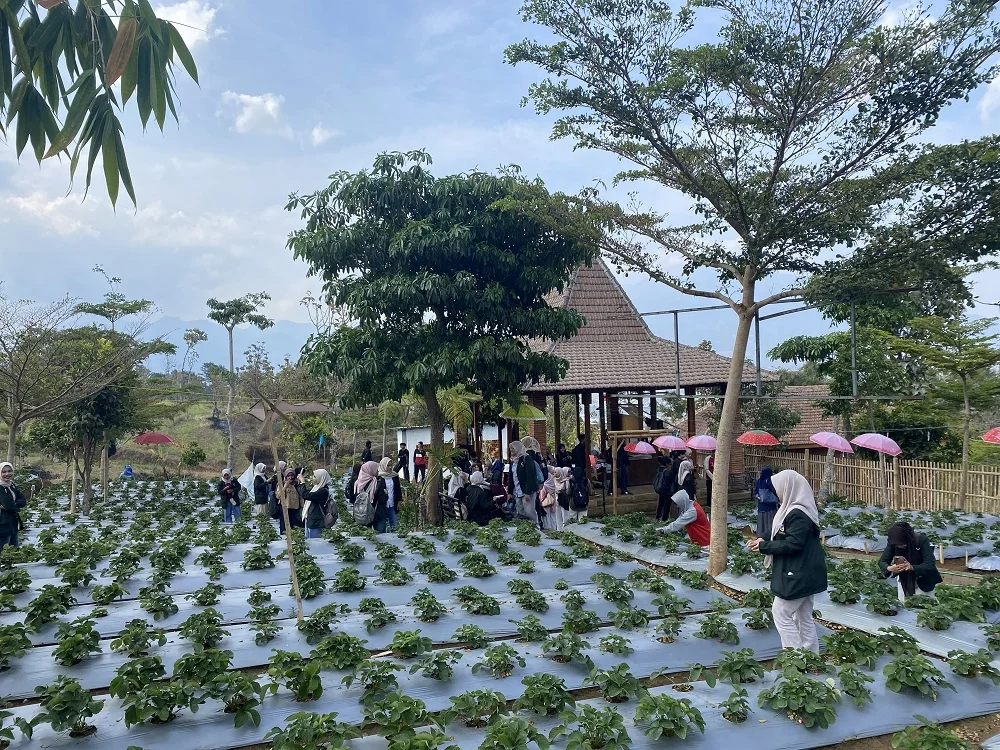
The group was also introduced to the development of strawberry picking tourism, which is being pioneered as an alternative tourist destination in Oro-Oro Ombo.
The development of agriculture-based tourism demonstrates an effort to diversify the village's economic activities so that it does not rely solely on previously established tourist attractions.
For the students, this experience provided a perspective on the relationship between resource management, business development strategies, and the creation of economic value for the community.
Connecting Accounting Theory with Field Practice
The KKL in Oro-Oro Ombo Village is part of the students' learning process to understand the application of accounting science outside the classroom environment.
Through the speakers' presentations and direct visits, students gained an overview of village government budget management, BUM Desa operations, MSME financial recording, and the utilization of local potential for economic activities.
The activity also demonstrated that the success of village economic development is not only determined by the scale of resource potential but is also influenced by the quality of governance, transparency, partnerships, and community participation.
This field experience is expected to broaden the students' horizons while improving their ability to understand the economic and financial issues faced by the community.
Oro-Oro Ombo Village serves as an example of how village governments, business actors, the community, and various partners can collaborate to develop the local economy sustainably.
The students who are members of Group 9 are Winda Alfitri Ayuhanas (08020224085), Carissa Azzahra Anianto (08030224087), Syeren Niti Fatimah (08030224091), Marissa Azzahra (08030224089), Amalia Fadillah (08030224143), Zahra Aulia R (08020224086), Elok Fitrotus Zakiyyah (08030224088), Alfinda Salsabilla (08040224095), Erna (08030224144), Aisah Rohma (08040224094), Alif Al Hilal Ahmad (08040224096), and Ahmad Fiyan Firdaus (08040224092).





Comments 0
Write a Comment Share your response