


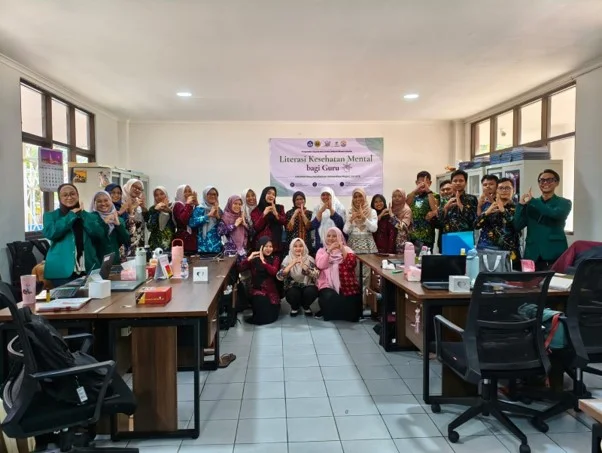
BEKASI, JurnalPost.com – Faculty members from the Guidance and Counseling Study Program at the Faculty of Education (FIP) of the State University of Jakarta (UNJ) provided mental health literacy education to teachers at Sekolah Rakyat Menengah Atas 13 Bekasi.
The Community Service activity (P2M) titled “Mental Health Literacy for Teachers” was held on Tuesday, 4 August 2026, from 13.00–16.00 WIB, at Sekolah Rakyat Menengah Atas 13 Bekasi, located at Jalan HM. Joyomartono No. 19, Margahayu Village, East Bekasi District, Bekasi City.
A total of 20 teachers participated in the event, which aimed to improve educators' understanding of mental health and their ability to recognize various signs of psychological issues that may arise among students in the school environment.
The event began with opening remarks from the Principal of Sekolah Rakyat Menengah Atas 13 Bekasi, Lastri Fajarwati, S.Pd., M.Pd. Following this, participants attended a presentation delivered by lecturers from the UNJ FIP Guidance and Counseling Study Program.
The P2M program was chaired by Dr. Eka Wahyuni, MAAPD, who also served as a speaker alongside Dr. Cut Munika Bastia Rahmadani, M.Pd.
In the first session, Dr. Eka Wahyuni discussed the basic concepts of mental health and various mental health issues commonly encountered in daily life.
The material provided teachers with an overview of the importance of mental health for an individual's development and life, including its impact on students' learning processes and social interactions at school.
Teachers were also encouraged to understand the importance of being able to recognize early warning signs when a student begins to experience issues related to mental health.
This understanding is considered crucial because teachers are among those who interact regularly with students and can play a role in providing initial support or directing students to appropriate assistance services.
The next session was delivered by Dr. Cut Munika Bastia Rahmadani. In her presentation, she discussed various factors that can influence or be associated with the emergence of mental health problems.
The discussion then continued with material on “Mental Health: Myths vs. Facts”, stigma surrounding mental health issues, signs that someone needs help, and the various types of accessible mental health services.
Through this material, participants were invited to distinguish accurate information from various misconceptions that still persist in society regarding mental health.
Teachers were also encouraged to build a more open perspective so that mental health issues are not viewed as something shameful or used as a basis for stigmatizing individuals who need support.
In addition to understanding the signs of mental health problems, participants received an explanation regarding the importance of the referral process to appropriate services if students are found to be in need of further assistance.
The role of the teacher in this context is not to provide a diagnosis, but to recognize conditions that require attention and to help students obtain support from parties with the appropriate competence for their needs.
Following the presentation, the activity continued with a discussion and question-and-answer session. The teachers appeared active in asking questions and discussing various mental health issues related to the educational environment.
The participants' enthusiasm showed that mental health issues are an aspect that receives attention in the process of supporting students at school.
The discussion also provided space for teachers to deepen their understanding of how to respond to students who show changes in behavior or specific emotional conditions in a more appropriate and proportional manner.
Through this Community Service activity, the UNJ FIP Guidance and Counseling Study Program seeks to strengthen the capacity of teachers in understanding mental health issues while increasing their sensitivity to the psychological conditions of students.
Good mental health literacy among educators is expected to support the creation of a school environment that is more caring, open, safe, and responsive to the psychological needs of students.
With increased teacher understanding, schools are also expected to become environments that not only support students' academic development but also provide space for their healthy social and emotional growth.







Comments 0
Write a Comment Share your response