


SEMARANG, JurnalPost.com – Six students from the Public Health Study Program at the Faculty of Medicine, Universitas Negeri Semarang (FK UNNES), have implemented 12 school health strengthening programs at SDIT Mutiara Hati, Semarang. The activities, which took place from September 16 to October 2, 2026, are part of the 'SKM Penggerak Pendidikan' (Public Health Practitioner as Education Catalyst) program within the school environment.
The program covers various aspects of health, ranging from monitoring student health conditions, sanitation and waste management, and hazard mapping, to strengthening School Health Unit (UKS) services.
Through these activities, the students not only applied the knowledge gained during their studies but also compiled a series of documents and supporting tools that the school can utilize to improve the management of its educational environment's health.
Group 25, stationed at SDIT Mutiara Hati, was supervised by Rudatin Windraswara, S.T., M.Sc. The group consisted of six students from five areas of specialization: Epidemiology, Environmental Health, Occupational Health and Safety (K3), Health Promotion, and Health Administration and Policy (AKK).
Each group member was responsible for developing two programs according to their field of expertise. Consequently, 12 programs were designed to address various school health needs.
Student Health Mapping and Illness Monitoring
In the field of Epidemiology, Cheryl Evelyn G.T. carried out two main activities: screening for student disease risk factors and mapping nutritional status and anemia.
These activities produced a profile of student health conditions, mapping results, and policy drafts that can be used as reference material for developing school health programs.
Meanwhile, Andini Massayu Wulandari developed a surveillance system for student health complaints. This program resulted in a surveillance report and a database containing information on student health issues.
Andini also conducted an analysis of risk factors related to healthy living behaviors. The results were compiled into an analysis report and policy draft to support efforts to prevent health problems in the school environment.
Both epidemiology programs were aimed at helping the school understand the health conditions of its students based on data collection and analysis.
Strengthening School Sanitation and Organic Waste Management
From the Environmental Health field, Salsabila Galuh Wijaya implemented the Clean and Healthy Toilet Movement.
This program focused on monitoring the cleanliness of school sanitation facilities, accompanied by the preparation of monitoring reports, modules, and educational media regarding the importance of maintaining toilet hygiene.
In addition to sanitation, Salsabila developed an organic waste management program through the creation of a simple composting unit.
The unit was designed as a means for processing organic waste as well as a learning medium for the school community regarding more environmentally friendly waste management.
This waste management program also produced a policy draft to support the school in developing its waste management system.
Hazard Identification and UKS Facility Evaluation
The aspect of school environmental safety was the focus of Laila Nurul Aziza from the Occupational Health and Safety (K3) specialization.
Laila carried out a hazard mapping program to identify various safety risks that might be found in the school environment.
The results of these activities were compiled into a hazard potential map and a policy draft that can be used for evaluation and as a consideration in accident prevention efforts.
Additionally, Laila conducted an inspection of the School Health Unit (UKS) facilities.
This inspection resulted in a report on the condition of the facilities and a policy draft expected to help the school evaluate the readiness of its health service support infrastructure for students.
Establishing Health Ambassadors and School GERMAS Campaigns
In the field of Health Promotion, Khansa Qudwah Amalia developed a program to establish School Health Ambassadors.
The program was aimed at encouraging student involvement in disseminating information and building healthy living habits within the educational environment.
The outputs of the activity included a Decree (SK) for the formation of Health Ambassadors and educational modules that can be used as coaching materials.
Khansa also implemented the School Healthy Living Community Movement (GERMAS) campaign.
This activity produced educational modules and policy drafts aimed at supporting the implementation of clean and healthy living behaviors in the daily activities of the school community.
Through these two programs, health promotion was not only carried out through the delivery of information but was also directed toward increasing student participation.
Drafting School Health SOPs and UKS Service Standards
Meanwhile, Nabil Faqih Haq from the Health Administration and Policy (AKK) specialization focused on strengthening school health governance.
Nabil compiled a Standard Operating Procedure (SOP) book for Healthy Schools, which contains procedural guidelines to support the implementation of health programs in the school environment.
The second program involved the preparation of a UKS Service Standards book as a guide for managing school health services.
Both documents are expected to help the school develop health services that are more directed, structured, and have clear implementation standards.
Handing Over Program Results to the School
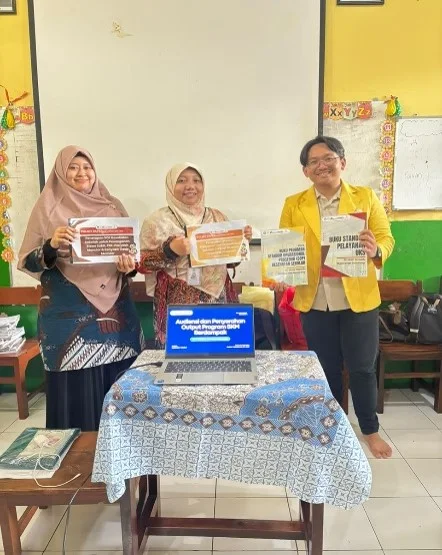
The entire series of activities by Group 25 of the SKM Penggerak Pendidikan program concluded with an audience with SDIT Mutiara Hati on Friday, October 2, 2026.
During the meeting, the students handed over various program outputs that had been compiled during the activities, ranging from health mapping reports, surveillance databases, and educational modules to hazard maps and SOP and UKS service standard documents.
These various results are expected to serve as a reference for the school in evaluating the health and safety conditions of the educational environment while designing sustainable improvement steps.
The implementation of this cross-specialization program also provided practical experience for the FK UNNES Public Health students in identifying health issues, formulating alternative solutions, and producing recommendations based on their respective competencies.
Through collaboration between students, supervising lecturers, and the school, the SKM Penggerak Pendidikan program has become a form of applying public health science in the primary education environment.
The results of these 12 programs are expected not to stop at the report compilation stage but to be utilized as a foundation for strengthening school health efforts and creating a learning environment that is healthier, safer, and more comfortable for students.





Comments 0
Write a Comment Share your response