


JurnalPost.com - Students from Yogyakarta State University (UNY) participating in the Community Service Program (KKN) have organized a poetry writing training program for children in Kedundang III Hamlet III, Temon District, Kulon Progo Regency, Special Region of Yogyakarta, which took place over three weeks on 13, 20, and 28August 2026. The community service project, titled "Pelita Kedundang" (Literacy Training and Children's Poetry Appreciation), focused on improving literacy skills and creative writing among elementary school students to foster an interest in literature from an early age.
Angelina Nimas, a studentof the Indonesian Literature Study Program at UNY and the program coordinator, explained that the initiative was born from observing the lack of creative literacy activities in rural elementary schools.
"We noticed that poetry writing was not a routine activity in schools, even though it is important for helping children express themselves through words. Therefore, we introduced this program so that students at SD Muhammadiyah Kedundang could have a new experience in learning language and literature," said Angelina Nimas.
She added that the materials were structured in stages according to grade levels so that every student could participate according to their individual abilities.
The program targeted 46 students in grades 4, 5, and 6 at SD Muhammadiyah Kedundang through three progressive sessions. Students in grade 4 were introduced to acrostic poetry themed "Things I Love," students in grade 5 learned about free-verse poetry themed "My World" along with an introduction to simple figures of speech, while students in grade 6 wrote reflective poetry themed "My Hopes and Memories." All 46 poems produced were compiled into an anthology book of 52 pages, printed, and presented to the school as documentation and appreciation for the students' work.
The phased implementation provided space for students to explore poetry according to their skill levels and the materials provided. Dividing the curriculum by grade level ensured the activity focused not only on the final written product but also on the process of discovering various forms of poetry. Students in grade 4 learned to compose poems using initial letters, students in grade 5 began to recognize the use of simple figures of speech in free-verse poetry, while students in grade 6 were guided to express their hopes and experiences through reflective poetry.
The series of activities also resulted in works that became part of the students' literacy experience. The 46 poems collected were not just the final output of the training but were also documented in an anthology book. The book serves as a form of appreciation for the students' writing while providing a written record of the literacy activities carried out during the "Pelita Kedundang" program.
Through this activity, literature was introduced in a way that relates to the students' own experiences and lives. The themes used for each grade level gave children the opportunity to write about things they know, ranging from things they love and the world around them to their hopes and memories. Thus, poetry writing became part of the learning process for translating ideas and experiences into literary works.
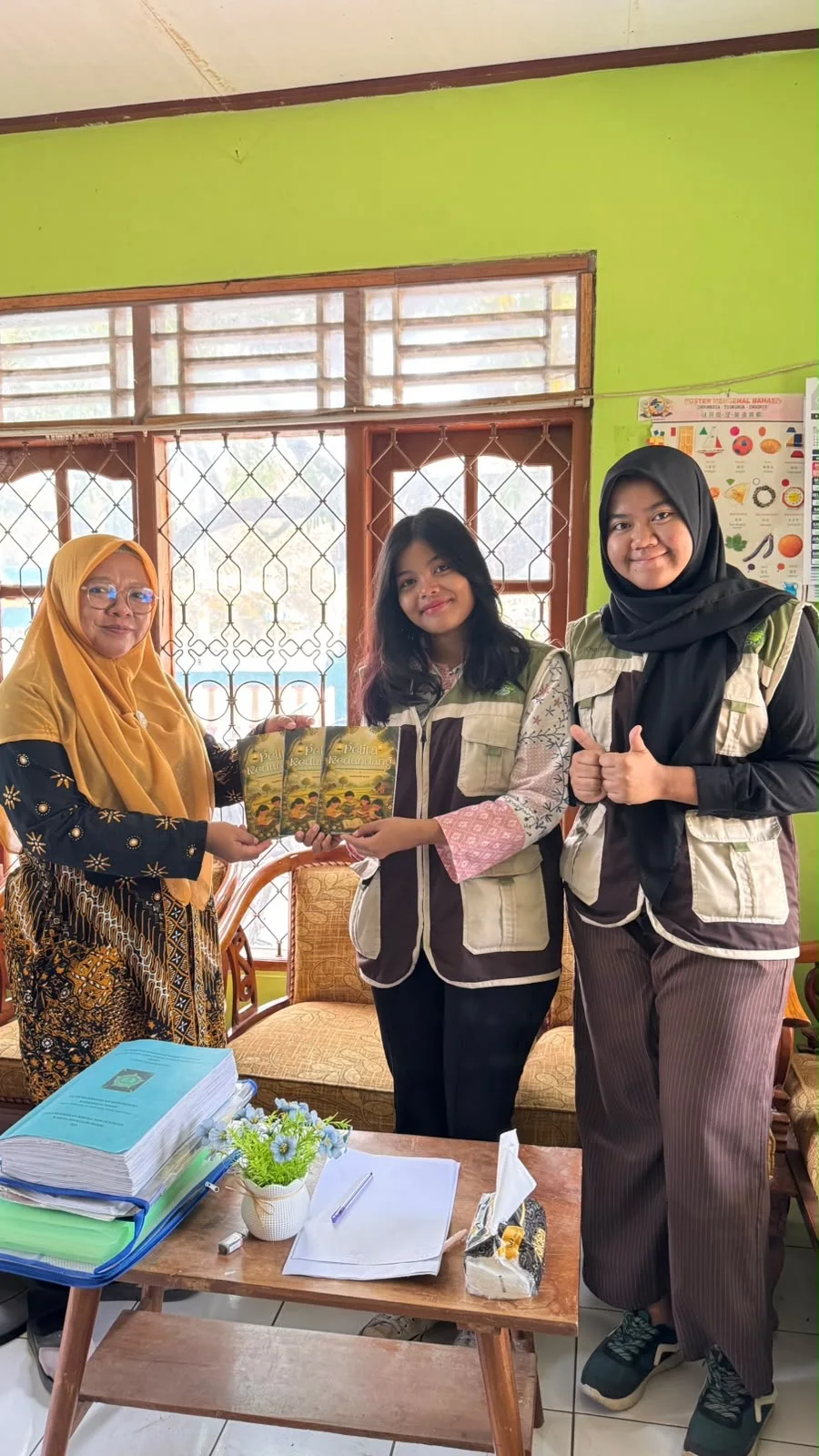
The presentation of the poetry anthology to the principal of SD Muhammadiyah Kedundang serves as a form of sustainability for the project. The book acts as both a record of student work and a tangible outcome demonstrating the results of the three-week training process. The program is expected to provide a memorable literacy experience for students and introduce the practice of appreciating and creating literary works within the school environment.
The "Pelita Kedundang" program aligns with the Sustainable Development Goals (SDGs) point 4, which is Quality Education. This activity directly contributes to improving the literacy and language skills of elementary school-aged children, in line with SDG target 4.6 regarding the improvement of literacy and numeracy, as well as target 4.7 regarding the strengthening of appreciation for culture and literature in education. Through a learning approach that is enjoyable and produces tangible outcomes in the form of an anthology book, this program is expected to encourage equal access to quality literacy education, especially for children in rural areas such as Kedundang III.
This KKN activity also supports the achievement of the university's Key Performance Indicators (IKU), namely:
Furthermore, this program is a concrete manifestation of the "Diktisaintek Berdampak" initiative, a collaboration between higher education and science-technology to address national strategic issues such as education, literacy, community welfare, and sustainable development.
By carrying the spirit of UNY Impact, the KKN activities in Kedundang III are expected to inspire similar programs in other villages, strengthening the synergy between students, lecturers, village government, and the community in driving change from the grassroots level.






Comments 0
Write a Comment Share your response