

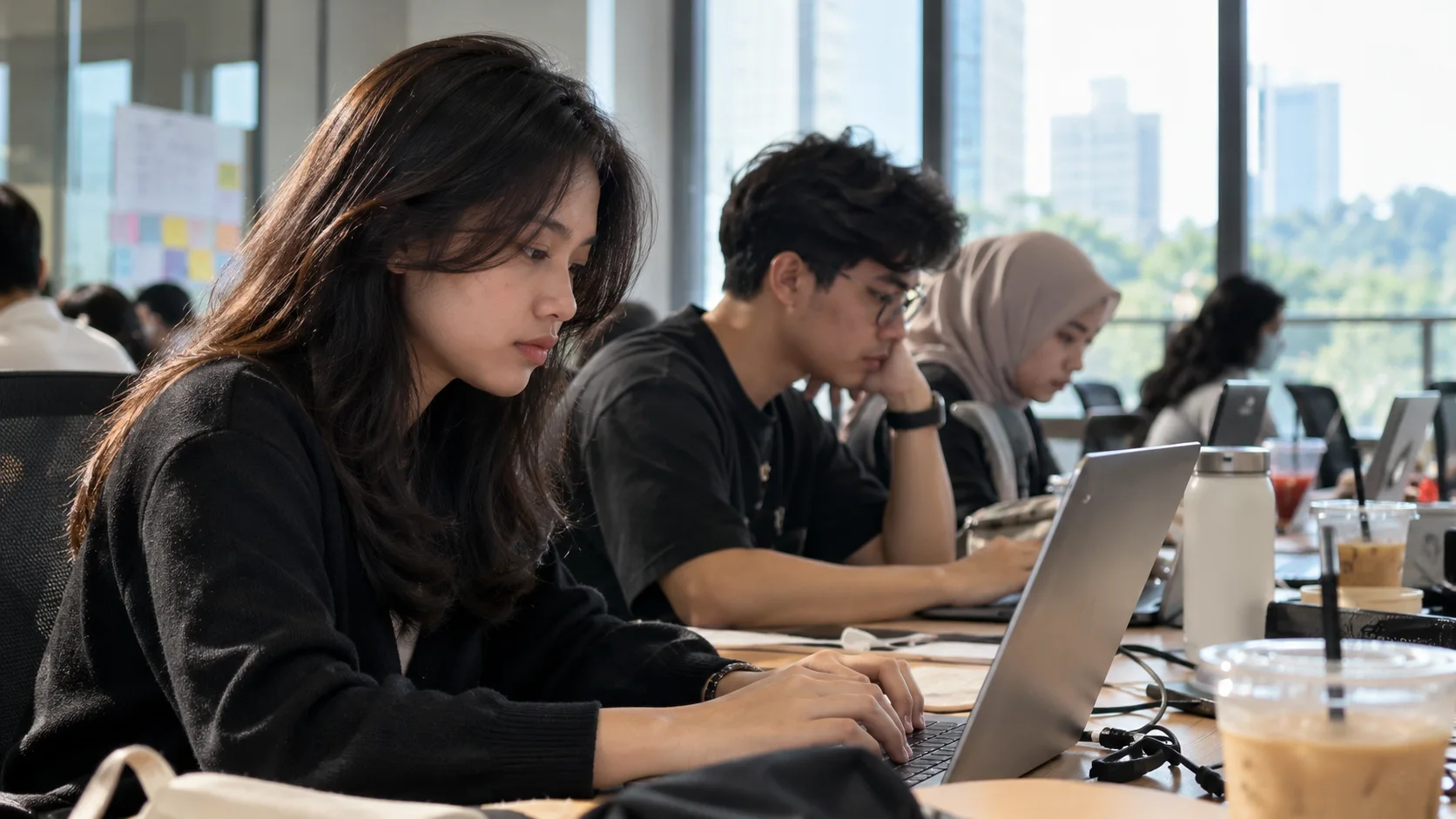
JurnalPost.com — The results of the 2020 Population Census by the Central Statistics Agency (BPS) show that Generation Z is the largest generational group in Indonesia, accounting for 27.94 percent (BPS, 2021).
Unlike Generation Y, who were born during a period of technological transition, Generation Z was born amidst the rapid development of the internet and increasingly sophisticated technology. The massive use of the internet, which is deeply integrated into the lives of Generation Z, has indirectly helped shape their character.
These characteristics include digital natives, expressive, multitasking, and the ability to interact intensely through social media. Alongside these positive impacts, there are also negative ones, including a decline in social skills, identity crises, and even internet addiction disorder.
The evolution of the modern workplace shows increasingly complex dynamics as a result of globalization, technological advancement, and digitalization across various organizational aspects. It is not only technical and structural elements that influence changes in contemporary workforce dynamics, but also the individuals involved.
The shift in workforce composition with the entry of Generation Z into the labor market is a significant change. With the arrival of Generation Z, different work principles and behaviors require human resource policies to adapt.
They bring distinct characteristics that directly impact organizational dynamics. One of the characteristics of Generation Z is their ability to adapt to technology, access information quickly, think critically, and remain open to change.
On the other hand, Generation Z also has specific expectations of the workplace, such as transparency, speed in decision-making, open communication, flexibility, and work-life balance. These characteristics and expectations require a responsive, inclusive, and trust-based work environment.
Research on flexible working hours and work-life balance among Generation Z employees shows that flexibility allows employees to work more efficiently at times and in places that are comfortable for them. Meanwhile, work-life balance can help reduce stress, increase motivation, and boost productivity.
Generation Z also tends to value this balance because it is not only related to well-being but can also be linked to work productivity.
These changing characteristics and expectations have led to differing views on Generation Z in the workplace. It is not uncommon for Generation Z to be considered less resilient to pressure, overly focused on comfort, or even less productive than previous generations.
However, this assumption needs to be viewed more critically. Workforce productivity is fundamentally not just about how long someone works, but also about how the input used can produce output efficiently and with quality.
So, do the differences in character and work expectations of Generation Z really show that they have low productivity? Or does this change actually indicate that the way of working and the needs of the workforce have shifted?
In this context, workforce productivity should not be viewed solely from the character of individual workers. Education that shapes the quality of human resources, the use of technology, the work environment, and labor systems are also important parts that can influence how a worker achieves optimal performance.
Productivity Is Not Only Measured by Time Spent Working
Workforce productivity is fundamentally related to the ability to produce output by utilizing input efficiently. Productivity cannot be seen only from how long someone is at the workplace, but also from efficiency, tangible results, and the quality of the work produced.
Thus, longer working hours do not always indicate a higher level of productivity. In the context of Generation Z, the perspective on working hours is becoming increasingly relevant because they have different characteristics and work expectations.
Generation Z tends to value flexibility in determining working hours and locations, as well as work-life balance. Flexible working hours allow workers to adjust their working time to conditions they consider most appropriate, so that work can be done more efficiently.
Meanwhile, work-life balance helps maintain a balance between work and personal life, which in such studies is associated with reduced stress, increased motivation, and work productivity.
This shows that productivity is also influenced by conditions that allow someone to work optimally. Factors such as flexibility, work-life balance, motivation, and a supportive environment are parts that need to be considered.
The research explains that a good work-life balance can increase satisfaction and productivity, especially for Generation Z. Conversely, an imbalance between work and personal life can cause stress, fatigue, and lower work morale.
Therefore, the assumption that Generation Z is not productive because they do not want to overwork becomes less accurate if productivity is only measured based on the length of working time.
A worker can work in a more measurable time but still produce effective and quality work. In this case, what is important is not merely how long Gen Z works, but how time, ability, technology, and working conditions can be utilized to produce optimal performance.
Changing Character and Work Expectations of Generation Z
The entry of Generation Z into the workforce brings different characteristics compared to previous generations. Generation Z grew up amidst the development of the internet and technology, thus having a strong affinity for technology, the ability to access information quickly, and a tendency to be open to change.
These characteristics also influence how they view and carry out their work. In an increasingly digitalized work environment, the ability to adapt to technology and change is one of the characteristics that can support the work process.
These differences are also seen in Generation Z's expectations of the work environment. They tend to value flexibility, work-life balance, open communication, and opportunities to grow.
Articles regarding Gen Z employee productivity show that flexible working hours and work-life balance are important for Generation Z. Flexibility allows workers to adjust their working time and place, while work-life balance can help reduce stress, increase motivation, and support productivity.
However, these changing expectations are often understood differently. When Generation Z questions overly rigid work cultures, desires flexibility, or does not make overworking a primary measure of success, it does not automatically show that they lack the willingness to work.
It is necessary to distinguish between rejecting a certain work culture and rejecting work itself. The desire for flexibility and work-life balance can be a form of adjustment to changing labor market conditions, not automatically indicating a low work ethic.
The change in perspective on work ultimately needs to be seen as part of the changing character of the labor market. The current world of work is not only undergoing changes in terms of technology but also in terms of the individuals who carry it out.
Therefore, the difference between Generation Z and previous generations should not be immediately interpreted as a decline in work ethic. What is more important is how these changing characteristics can be accommodated through a work environment that is responsive, open, and capable of leveraging Generation Z's characteristics to support productivity.
Education and Skill Mismatch in the World of Work
In addition to individual character and perspectives on work, productivity is also influenced by the surrounding labor system.
A worker does have a responsibility to improve their skills and provide the best results, but conditions shaped by education, companies, and the government also determine whether those skills can be used optimally.
Therefore, when worker productivity is low, it is not always accurate to blame the worker directly.
One issue that needs attention is skill mismatch, which occurs when a person's education or skills do not match the job they are performing.
BPS, in its publication regarding Mismatch between Education and Employment of Indonesian Youth , shows that more than a third of youth work in jobs that do not match their level of education.
BPS also explains that conditions of being overeducated and undereducated can lead to wage penalty and economic inefficiency. This shows that the issue of productivity is also related to how well education is able to prepare someone to enter the workforce.
This problem is important when linked to Gen Z. They may have sufficient education, but it does not necessarily mean the job obtained is truly in line with their field and abilities.
If such a mismatch occurs, low productivity cannot simply be considered proof that workers are lazy. It could be that workers need time to adjust or need additional skills to meet job demands.
Therefore, the relationship between education and the needs of the world of work is one of the things that needs to be improved.
The Importance of Upskilling and Reskilling for the Workforce
Besides the alignment of education and work, workers also need opportunities to continue learning. Technological changes make the skills required by companies change as well.
The World Economic Forum in the Future of Jobs Report 2025 estimates that about 39 percent of core worker skills will change by 2030.
The report also shows that upskilling and reskilling are becoming increasingly important as companies face rapidly changing skill requirements.
This means the responsibility for improving skills does not lie solely with the worker. Companies also need to provide opportunities for workers to learn and develop their abilities.
This is seen in the 2025 PwC survey. In Indonesia, 64 percent of non-managerial workers said they had access to the learning resources they needed, while at the senior executive level, the figure reached 89 percent.
This difference shows that opportunities to grow are not necessarily felt equally by all workers.
Work Environment, Recognition, and Technology Utilization
The work environment cannot be separated from productivity. Workers in an environment that is open to learning, communication, and skill development will have more room to grow.
The PwC survey shows that 72 percent of workers in Indonesia say their teams view failure as an opportunity to learn and grow.
In addition, workers in Indonesia are also quite open to expressing opinions and ideas about work. Conditions like this show that work culture can help shape how workers use their abilities.
Another thing that needs attention is wages and recognition. Workers certainly hope that the contributions they make can be appreciated appropriately.
In the PwC survey, 53 percent of workers in Indonesia reported receiving a salary increase in the last year, while 10 percent reported receiving a promotion.
This data does not mean that a salary increase automatically makes workers more productive. However, recognition and opportunities to grow remain part of the working conditions that can influence the experience and motivation of workers.
The most visible change in the world of work today is the increasingly widespread use of technology and artificial intelligence (AI).
Generation Z, who grew up close to technology, has the opportunity to utilize these developments in their work.
PwC found that in Indonesia, 96 percent of workers who use generative artificial intelligence (GenAI) every day reported an increase in productivity, while for workers who rarely use it, the figure was 75 percent.
However, the use of AI in Indonesia is not yet evenly distributed. As many as 69 percent of respondents said they had used AI for work in the last year, but only 16 percent used it every day.
This shows that technology alone is not enough. Workers need to have the ability to use it, while companies need to provide access, training, and clear usage rules.
The World Economic Forum also shows that AI and big data, network and cybersecurity, as well as technological literacy are among the skills expected to become increasingly important until 2030.
Thus, the ability to adapt to technology becomes an important part of workforce productivity in the future.
Productivity Is a Shared Responsibility
From these various points, it can be seen that productivity is not only determined by whether someone wants to work hard or not.
Education, job suitability, learning opportunities, work environment, reward systems, and technology are all interconnected.
Therefore, it is inaccurate to burden the issue of productivity only on workers, including Gen Z. Workers do have a responsibility to continue to develop, but companies, educational institutions, and the government also help shape the conditions that determine whether a worker can work productively.
Ultimately, the question “Is Gen Z really lazy and unproductive?” is not enough to explain the issue of workforce productivity.
The differences in character and Gen Z's perspective on work do not automatically show that they have low productivity.
They do have different expectations, such as wanting flexibility, open communication, opportunities to grow, and a balance between work and personal life.
However, these changes are also part of the changing world of work, which is increasingly influenced by technology and digitalization.
Productivity itself is not only determined by how long someone works. Productivity is related to how the workforce, skills, technology, time, and work environment can be used to produce output that is effective and of high quality.
Problems such as the mismatch between education and work, limited training opportunities, work environment, reward systems, and the ability to utilize technology also need to be addressed.
Therefore, Indonesia's challenge is not just how to make Gen Z work longer, but how to create a workforce that is more skilled, adaptive, and capable of producing added value.
Gen Z needs to continue to develop, but the systems around them must also be able to provide room for growth.
Efforts to Increase Generation Z Productivity
From the Gen Z side, increasing productivity can start from the willingness to continue learning and improving competence.
Gen Z needs to develop hard skills as well as soft skills, keep up with technological developments, perform upskilling and reskilling, and maintain a work ethic and responsibility.
The ability to adapt is becoming increasingly important because the needs of the world of work continue to change.
From the company side, companies need to provide opportunities for workers to develop their abilities through training and learning that are in accordance with job requirements.
In addition, companies need to create a work environment that supports communication, learning, and career development.
Technology and AI also need to be utilized to assist work, not just replace the workforce. Recognition of workers also needs to be given fairly and in line with the contributions and responsibilities provided.
From the government side, there needs to be an effort to strengthen the relationship between education and the needs of the world of work.
Education is not enough just to produce graduates, but it also needs to ensure that the skills possessed are in accordance with the needs of the labor market.
The government also needs to expand access to training, certification, upskilling, and reskilling, especially to face technological changes.
Labor policies also need to be continuously adjusted to changes in work patterns and skill requirements in the digital era.
Thus, the discussion regarding Gen Z should not stop at the question of whether they are lazy or diligent. What is more important is to see how Gen Z, companies, educational institutions, and the government can work together to create working conditions that allow productivity to increase.
Ultimately, productivity is not just about how long someone works, but about how much value can be generated from the abilities, time, technology, and work environment available.
Bibliography
Central Statistics Agency. (2025). Statistical data stories for Indonesia: Mismatch between education and employment of Indonesian youth: Implications for the demographic bonus. Central Statistics Agency.
PwC Indonesia. (2025). Global workforce hopes and fears survey 2025: Indonesia. PwC Indonesia.
World Economic Forum. (2025). The future of jobs report 2025. World Economic Forum.
World Economic Forum. (2025). The future of jobs report 2025: Skills outlook. World Economic Forum.









Comments 0
Write a Comment Share your response