

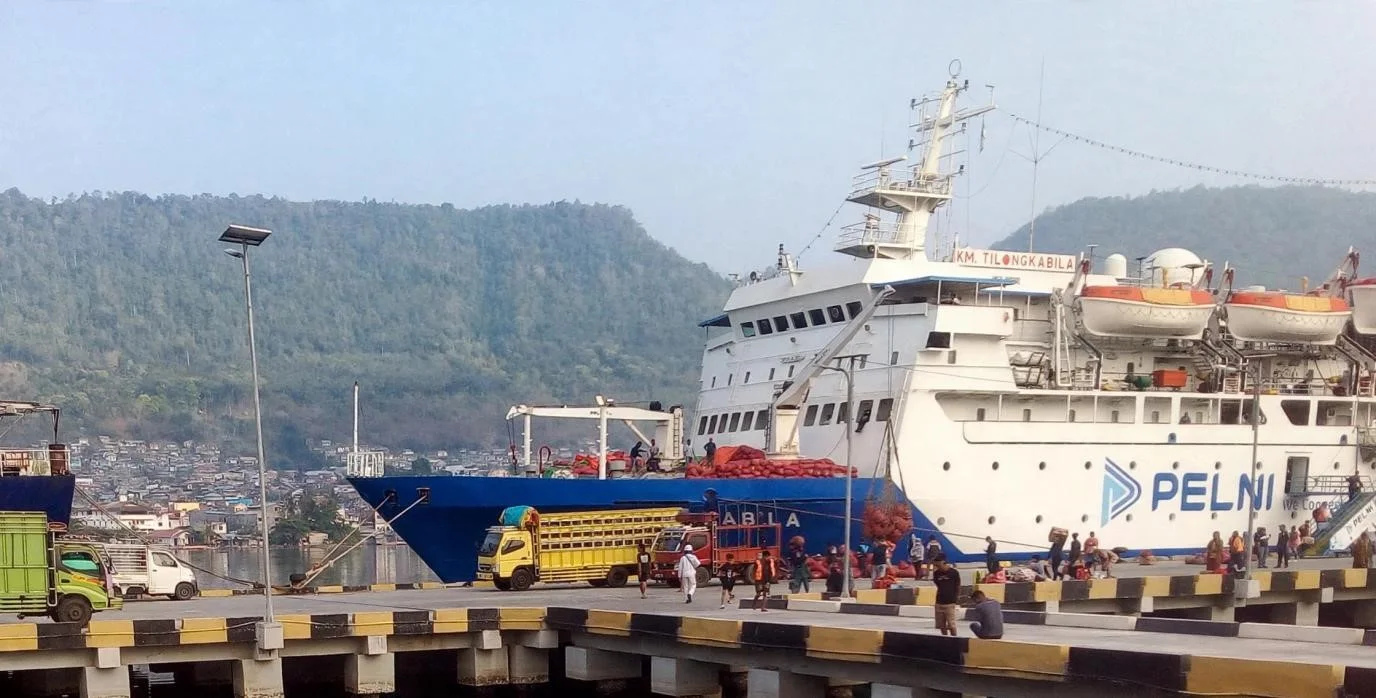
JurnalPost.com - “Crew to the deck, prepare fore and aft. Crew to the deck, prepare fore and aft. Prepare the ship for starboard/port docking. Prepare the ship for starboard/port docking.”
This call has become a familiar sound to passengers of the KM Tilongkabila whenever the ship approaches a port. On board, the crew prepares for the docking process, while on land, a crowd waits for its arrival.
They are the port community—baggage handlers, taxi drivers, and street vendors—who depend on the ship's activity and its passengers for their livelihood.
When the KM Tilongkabila finally docked, I witnessed a compelling scene. It was not merely the meeting of a ship and a pier, but a convergence of lives, each with their own interests and hopes.
This sight accompanied my solo journey from Gili Mas Port, Lombok, to Gorontalo Port from October 15 to 20, 2026.
My final destination was Domisil Moonow Village, Sangtombolang District, Bolaang Mongondow Regency, North Sulawesi. From Gorontalo, the journey required an additional five to six hours by land.
During my time on the KM Tilongkabila, I had the opportunity to observe activities at nine ports: Gili Mas, Bima, Labuan Bajo, Makassar, Bau-Bau, Raha, Kendari, Luwuk, and Gorontalo.
Each port has its own unique atmosphere, yet one commonality remained: the arrival of the ship always brings a flurry of activity and creates income opportunities for the local community.
Life Aboard the KM Tilongkabila
Waiting for the ship to dock gave me the chance to observe the lives of the passengers, if only briefly.
Most chose to sleep or lie down to rest. Others were busy on their mobile phones, calling family back home, or chatting with fellow passengers.
One scene that caught my attention was a passenger from Lombok busy making mango rujak. They had a complete set of tools, from a mortar and pestle to chili and various spices.
Amidst these diverse activities, I also noted the reading habits of the passengers. Throughout my observation, the number of people seen reading a book could be counted on the fingers of one hand.
On the outer decks, specifically the left and right sides of decks five and six, there are several chairs where passengers can relax and enjoy the sea view.
Deck five has three chairs on the right and five on the left. Meanwhile, deck six has seven chairs on the right and six on the left. Each chair can accommodate up to three people.
This area is also frequently used by passengers who smoke, as smoking is prohibited inside the ship to prevent fire hazards.
It is in these spots that conversations between passengers often take place.
“Where are you departing from?”
“Where are you from originally?”
“Where are you getting off?”
“Where are you headed?”
“What is the purpose of your trip?”
These simple questions serve as icebreakers. Sometimes the conversation develops into a long story, but often it ends after a few questions.
Interestingly, names are rarely asked. Passengers are more interested in knowing where someone is from, where they are going, and why they are traveling.
Baggage Handlers: Racing Against Time
Whenever the ship approaches a port, the baggage handlers prepare themselves. They are an inseparable part of the loading and unloading process for passenger luggage.
At every port I visited, the baggage handlers typically wore uniforms to identify their profession.
The colors of the uniforms varied. At Gili Mas Port, for instance, I saw orange and blue uniforms. In Bima, sky blue was more dominant, while in Labuan Bajo, they wore dark red.
In Makassar, the baggage handlers wore brown uniforms. In Bau-Bau, orange and red were visible, while in Raha, there were several colors, such as sky blue, green, red, and orange.
In Kendari, I saw light green and sky blue uniforms. In Luwuk, there were dark red and orange uniforms, while in Gorontalo, the baggage handlers wore blue.
Moments before the ship fully docked, they were already waiting at the edge of the pier. Some were seen assisting with docking preparations, such as catching the mooring lines and setting up the gangway.
As soon as the ship's doors opened, the sound of footsteps became boisterous.
The baggage handlers rushed into the ship, navigating through the corridors to find passengers who might need help with their belongings.
When they met a potential client, a negotiation usually followed. The fee was not always fixed, as it depended on the agreement reached.
In my view, their work deserves respect. They rely on their physical strength and the available opportunities to earn an income.
After reaching an agreement, the baggage handlers carry the passengers' luggage to the parking area. If the distance is significant, they use carts, as I saw at Bungkutoko Port, Kendari.
Amidst this bustle, passengers should avoid crowding the ship's corridors. The baggage handlers need space to move quickly, unload goods, and return to the ship to serve other passengers.
Their work is not limited to moving goods from the ship to the shore; they also help prospective passengers carry items from the parking area onto the ship.
At Luwuk Port, I even saw several baggage handlers standing on the roadside near the port, watching for incoming vehicles.
When a car signaled its intent to enter the port area, two or three of them would immediately approach. Some followed the slow-moving vehicle, even peering through the windows to see if the passengers needed help with their luggage.
A similar scene was observed in Bima. A baggage handler was seen at the side of a pickup truck carrying prospective passengers.
This activity highlights how vital the ship's arrival is for them. The opportunity to secure a customer must be seized amidst competition and limited time.
Taxi Drivers and the Hope for Passengers
Besides baggage handlers, taxi drivers are another group that welcomes the ship's arrival.
They usually gather around the exit gate to offer transportation services to passengers who have just disembarked.
“Need a taxi?” or “Is anyone picking you up?” are questions frequently heard.
If they see a passenger sitting with their luggage, some drivers will approach to offer a ride to their destination.
For passengers, their presence can be convenient, especially if they do not have a ride waiting.
For the drivers, every docking ship presents an opportunity to gain a customer.
Street Vendors Pinning Hopes on the Ship's Arrival
The arrival of the KM Tilongkabila is also an opportunity for street vendors to earn an income.
Some vendors sit near the ship's entrance and exit, waiting for buyers. Others walk through the passenger decks carrying various goods.
Some sell instant noodles, rice, cigarettes, clothing, and other necessities. They continue to offer their wares until close to the ship's departure time.
About fifteen minutes before the ship sets sail again, the vendors begin to leave the vessel.
Among them, I also saw children who appeared to be of school age. Based on their appearance, I estimated some were under fifteen years old.
These children walked from one room to another carrying their merchandise.
Seeing noodles and cigarettes in their hands, I felt as though I were witnessing children who had been introduced to the responsibilities of adult life far too early.
In their faces, I caught a glimpse of something that could only be described as hope.
Trading activity does not only take place on the ship. The port area is also filled with vendors offering food, drinks, and various necessities for passengers.
Some sell orange juice, bottled water, and bread while walking from one place to another. When their stock runs out, they return to get more and continue selling.
At Bima Port, I saw several vendors even selling their goods near the departure terminal entrance.
Yet, on one of the walls, there was a sign that read:
“Street Vendors Prohibited from Selling in This Area.”
However, the selling continued. Perhaps the necessities of life make such prohibitions difficult to fully enforce.
Still in Bima, about fifty meters from the terminal, right behind the port's boundary wall, I heard a woman offering shallots.
“Eeee. Shallots, shallots. Shallots here,” she shouted to the people passing by.
Her voice was clearly audible amidst the port's activity.
At that time, it was around 11.30. The sun felt scorching. Nothing protected the woman's head except for the red hijab she was wearing.
Meanwhile, some other vendors were able to sit in the shade under large umbrellas.
That simple scene made me realize once again that the struggle to earn a living has many different faces.
An Encounter with a Child at Makassar Port
Among the various experiences during the trip, one event at Makassar Port left a deep impression.
While walking through the crowd of vendors, a small child approached me and tugged at my shirt.
I estimated his age to be around six to seven years old. In the vicinity, I also saw other children who appeared to be older.
The child tugged at my shirt several times, hoping to receive money.
However, I did not give him any immediately.
At that moment, I was filled with hesitation. I worried that giving money would only make him think that begging was an easy way to obtain something.
However, after leaving the place, I felt a sense of guilt for not taking any money out of my wallet.
I realized that the issues faced by the child were certainly not as simple as the decision to give or not give money.
Perhaps there were family circumstances, economic hardships, or other issues I was unaware of.
To this day, that experience leaves me with a hope: that the child may have the opportunity to live a life like other children, including learning, playing, and enjoying his childhood.
KM Tilongkabila, More Than Just a Passenger Ship
Traveling with the KM Tilongkabila provided an experience far broader than just moving from one region to another.
At every port, I witnessed how the ship's arrival drives community activity.
For passengers, a docking ship means their journey is closer to its destination. Some are going to meet family, start a job, or continue their journey to another region.
However, for the port community, the sound of an approaching ship carries a different meaning.
For baggage handlers, the ship's arrival means an opportunity to offer their labor. For taxi drivers, it opens the chance to transport passengers. For street vendors, every passenger disembarking or boarding could be a customer.
They work in their own ways, facing competition, the heat of the sun, and the constraints of time.
The experience of the six-day journey made me understand that a ship does not only carry people and goods.
The ship also carries economic opportunities, brings together diverse lives, and sustains the hopes of the community around the port.
The KM Tilongkabila, for me, is not merely a means of sea transportation. At every dock it visits, there are always people waiting, working, and hoping to earn a living.
When the ship leaves the port again, some passengers continue their journey to the next destination, while the port community returns to their daily lives, waiting for the opportunity that comes with the next ship.
And that is where I see another meaning of travel: it is not just about the places we go, but also about the lives of the people we meet along the way.
About the Author
M. Zainul Arifin is from East Lombok, West Nusa Tenggara. He is a member of the Buya Syafii Reading Class Community in East Lombok and currently resides in Bolaang Mongondow Regency, North Sulawesi.








Comments 0
Write a Comment Share your response