


KLATEN, JurnalPost.com — Students from the Community Service Program (KKN) at Yogyakarta State University (UNY) in Paseban Village, Bayat District, Klaten Regency, have developed a lime and lemongrass syrup as a way to utilize the village's local potential.
The program, titled “Innovation of Lime and Lemongrass Syrup Products Based on Paseban Village Potential,” utilizes limes that have been cultivated by local residents and are also available in the gardens owned by the Paseban Village-Owned Enterprise (BUMDes).
The product development serves as an alternative use for limes, especially when harvest yields increase. By processing them into syrup, limes are not only used in their fresh state but can also be developed into processed products with added value.
In the long term, the lime and lemongrass syrup is also considered to have the potential to be developed as a local product marketed around the Pandanaran Tomb area. This area is a key location for introducing processed products from Paseban Village to both the local community and visitors from outside the region.
This program was carried out by a UNY KKN group led by Aquilla Aleeazahra along with nine members: Novita Indah Sari, Anggie Riesmawati Ramelan, Ikrimah Andini Atmaranti, Audy Kirana, Ryan Hanafi Nurwahid, Muhammad Faiz Al Kamal, Rheza Renardi Pratama, Syechan Fawwas Abiyyu, and Aril Muhammad Fasha.
The activity took place at Joglo Pandanaran 9 on Monday (9/21/2026), involving the residents of Paseban Village. During the event, the KKN students demonstrated the syrup-making process and explained the production stages to the participants.
Through the live demonstration, the community was introduced to ways of processing limes available in the village environment into a beverage with a different form and presentation.
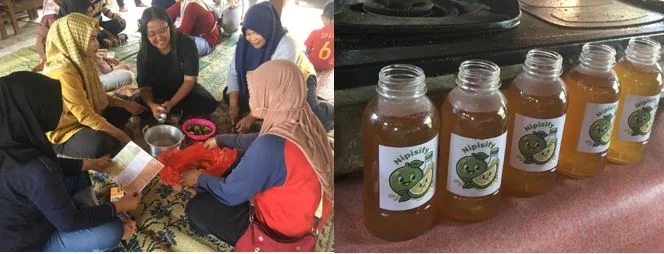
Limes were chosen as the main ingredient because their availability is directly linked to local cultivation activities and the Paseban BUMDes gardens. Processing these harvests into a beverage is expected to provide an alternative use when yields are abundant.
From Ingredient Selection to Processing
During the activity, the students also explained the characteristics of limes that are considered suitable for use as raw materials. The limes used should ideally have thin, smooth skin, a fresh or yellowish-green color, contain plenty of juice, have a strong aroma, and be free from damage or mold.
Selecting raw materials is a crucial step because the condition of the fruit can affect the taste, aroma, and characteristics of the final product.
The syrup is made using limes, granulated sugar, lemongrass, boiled water, and carboxymethyl cellulose (CMC) as a thickening agent.
To produce approximately 200 ml of syrup, the formulation introduced consists of five limes, 150 grams of granulated sugar, one stalk of lemongrass, 150 ml of boiled water, and about 1–1.5 teaspoons of CMC.
The addition of lemongrass is used to provide extra aroma and flavor character, resulting in a variation that differs from using limes alone.
The processing method was introduced using relatively simple equipment, such as pots, a stove, a citrus juicer, knives and cutting boards, teaspoons, a digital scale, gloves, and 200 ml bottles.
The use of easily accessible equipment demonstrates that the syrup-making process can be replicated by the community using relatively simple tools.
The KKN students also introduced the characteristics of the product as a lime and lemongrass-based beverage. During the session, both ingredients were highlighted for their antioxidant content and their use as beverage components.
Production Cost Calculation
In addition to the processing aspect, the activity also covered simple calculations regarding production costs and sales potential.
Based on the KKN group's calculations, the raw material requirements to produce 30 bottles of 200 ml syrup amount to Rp366,600, while operational costs are estimated at Rp59,000.
Thus, the total production cost listed in the activity materials reaches approximately Rp425,600.
This calculation is intended to provide an overview of the various cost components that need to be considered if the product is to be developed into a business.
In the KKN group's simulation, the product is projected to be sold at Rp20,000 per bottle with a target margin of around 40 percent. Based on these figures, the profit is estimated to be in the range of Rp5,500 per bottle.
The simulation serves as an initial guide for the community to calculate raw material needs, production costs, packaging, and pricing if the lime and lemongrass syrup is developed commercially.
The 200 ml product is also considered practical enough to be developed as a local product option in the trading area around the Pandanaran Tomb.
If it can be produced sustainably, the lime and lemongrass syrup has the potential to be developed as a souvenir option while simultaneously introducing the local potential of Paseban Village to visitors.
Further Development Still Needed
However, developing the lime and lemongrass syrup into a commercial product still requires several subsequent stages.
Consistency in taste and product quality, packaging information and design, production process management, pricing, marketing strategy, and compliance with food safety regulations all need to be addressed if the product is to be produced and marketed sustainably.
These steps are important if the community or business groups in Paseban Village plan to continue product development after the KKN program concludes.
The activity at Joglo Pandanaran 9 also served as a space for knowledge sharing between students and the community regarding the utilization of local agricultural produce.
Through hands-on practice, the community gained insight into the opportunities for processing materials available in the village into products with new applications.
The “Innovation of Lime and Lemongrass Syrup Products Based on Paseban Village Potential” program is expected to be an example of product diversification based on local resources.
The use of limes cultivated by the community and the BUMDes garden is not only aimed at meeting needs in fresh form but can also be developed into processed products with broader utility.
This innovation also opens opportunities for the community to develop other products according to the potential available in Paseban Village. With proper processing and gradual business development, the village's local potential can be directed toward products that provide economic benefits while strengthening the identity of Paseban Village.





Comments 0
Write a Comment Share your response