

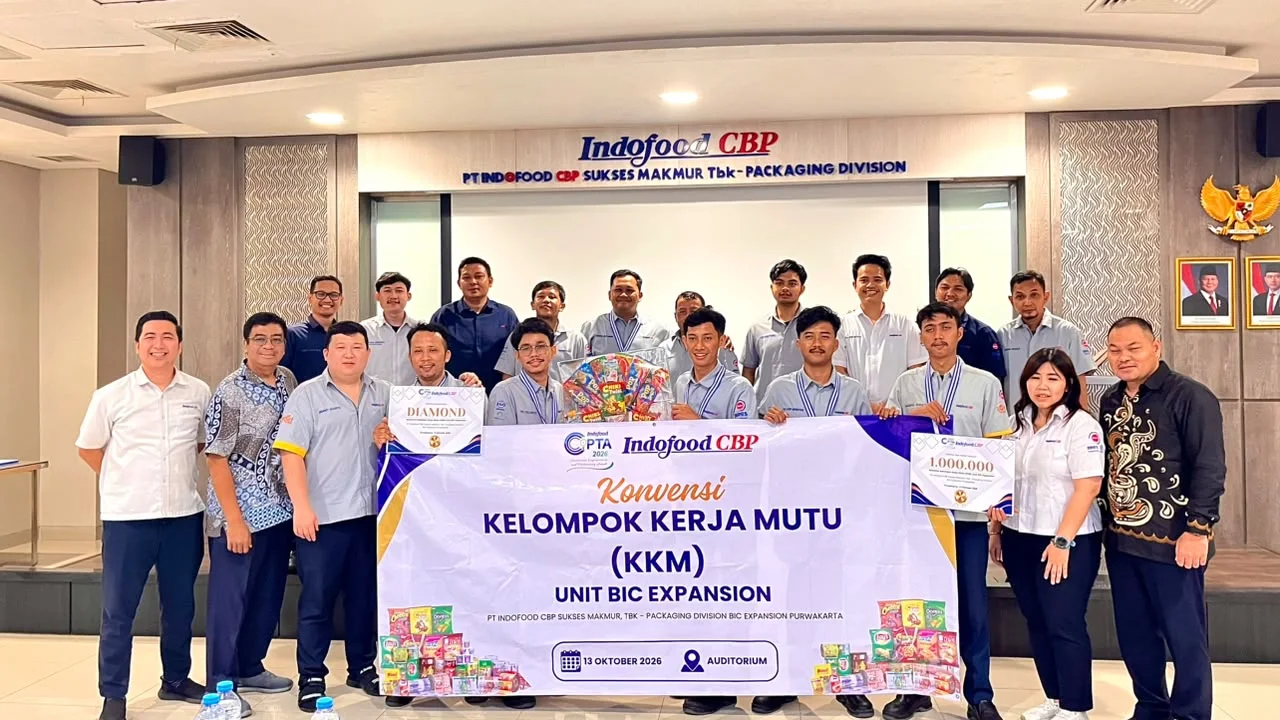
PURWAKARTA, JurnalPost.com – PT Indofood CBP Sukses Makmur Tbk continues to enhance the quality of its flexible packaging production through various internal innovations. One such initiative comes from the SPEED (Slitting Process Effective Development) team, which has successfully developed technology to mitigate material thickness issues and roll instability during the production process.
The innovation, developed at the Flexible Packaging unit, BIC Expansion, has reduced the sorting percentage caused by thickness issues and material curling in Noodle products from 41 percent to 28 percent.
These results were achieved through a series of production process improvements throughout 2026, ranging from the development of auxiliary tools for slitting machines and the refinement of material thickness standards to the implementation of Internet of Things (IoT) technology for real-time machine monitoring.
Beyond impacting production quality, this program has also demonstrated success in reducing plastic waste and increasing the company's operational cost efficiency.
Starting from Packaging Thickness Issues
The development of the SPEED team's innovation stemmed from the high volume of packaging material that required sorting due to uneven thickness and material curling during the roll-cutting process.
Based on production evaluations from April to June 2026, thickness issues were the largest contributor to the Noodle product sorting category, reaching 41 percent.
This condition is related to the extrusion lamination process, which involves bonding multiple layers of packaging material using liquid polymer as an adhesive.
During this process, thickening can occur at the edges of the material, known as 'edge bead.' This thickness variation can cause instability when the material enters the slitting machine.
The problem is further complicated because the automatic thickness control system, or auto dies, has not been able to optimally cover the entire edge of the material.
After analyzing the root causes, the SPEED team established several improvement steps to reduce the amount of material requiring sorting while increasing production process stability.
1The SPEED team planned
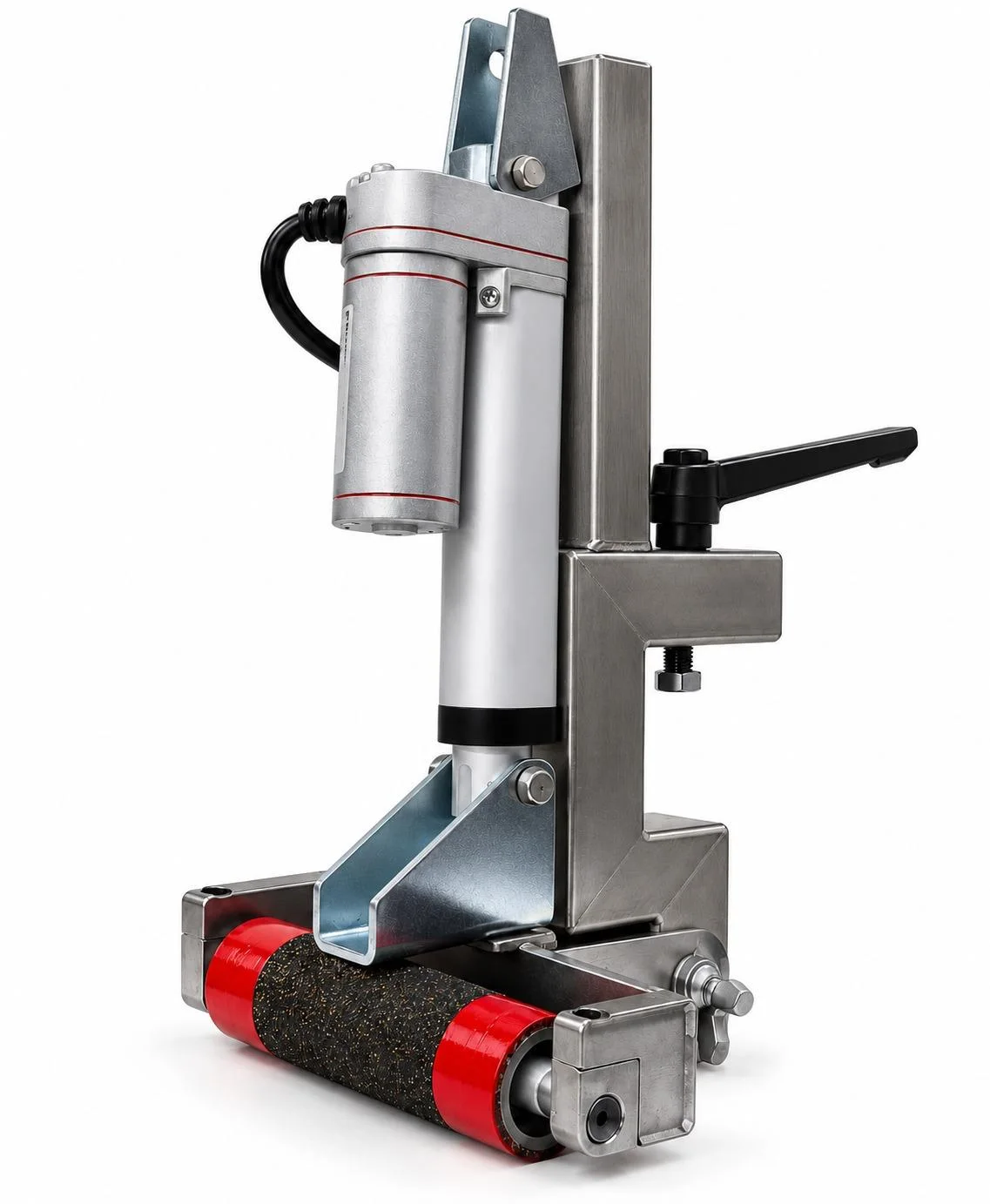
The VR-Stabilizer (Volt Roll-Stabilizer) prototype, an electric-based tool developed by the Indofood CBP SPEED team to maintain the stability of packaging material edges on slitting machines, helping to reduce thickness and curling issues during production. (Photo: SPEED Team Documentation)
Developing the VR-Stabilizer to Maintain Material Stability
One of the key innovations developed is the VR-Stabilizer (Volt Roll-Stabilizer), an edge-pressing tool for film installed on slitting machines.
The development of the tool was carried out in stages through several tests.
In the initial stage, the team attempted to use a simple tool—an Allen key—to hold the edge of the material. This test reduced the amount of sorting due to thickness issues by 13.41 percent, but it did not provide optimal results in terms of stability or operational safety.
The team then developed a manual prototype that allowed for more precise positioning of the film edge press. The second test resulted in a 27.38 percent reduction in sorting.
Development continued with the introduction of an electric-based prototype. At this stage, the position of the pressure roller could be adjusted using a drive system, making operation more practical and consistent.
Test results showed a 34.18 percent reduction in sorting due to thickness issues compared to the baseline conditions during that test.
This success became one of the foundations for implementing the VR-Stabilizer as part of the production quality improvement program.
Integrating IoT Technology for Machine Monitoring
In addition to mechanical modifications, the SPEED team developed an Internet of Things (IoT)-based machine monitoring system integrated with a Programmable Logic Controller (PLC).
This technology allows various production process parameters to be monitored in real-time via a digital dashboard.
The system is also equipped with an alert history log and sends notifications via WhatsApp if machine parameter deviations are detected.
With this system, operators and the technical team can obtain information faster to perform inspections or corrective actions.
In internal evaluations, IoT integration also improved the ability to detect process deviations. However, the frequency of machine cleaning actions also increased, making machine downtime due to these activities a point of focus in efficiency evaluations.
The SPEED team also adjusted the material thickness tolerance range from ±2 micrometers to ±1 micrometer.
Based on the process capability evaluation results listed in the project report, the Process Capability Index (Cpk) value increased from 1.14 to 1.34 after the implementation of the new standard.
This change is part of the company's efforts to strengthen the consistency of packaging material quality.
Sorting Decreases, Plastic Waste Reduced
The implementation of these improvements showed results in the production evaluation for the period of July to September 2026.
The percentage of sorting due to thickness and curling issues on Noodle products dropped from 41 percent in the April–June period to 28 percent after the improvements.
This means the SPEED team achieved a 32 percent reduction, surpassing their target of 26 percent.
Another impact is visible in the amount of plastic film waste generated through the production and rewinding processes.
Before the improvements, the amount of waste was recorded at 337,178 meters. After the program was implemented, that figure dropped to 163,296 meters.
Thus, there was a waste reduction of 173,882 meters, or approximately 51.5 percent, based on project evaluation data.
This decline demonstrates that quality improvement efforts are not only related to production output but can also support more efficient raw material usage.
Potential Cost Savings of Up to Rp1.6 Billion per Year
Financially, the SPEED team also evaluated the cost savings generated through reduced sorting, decreased rewinding processes, and production time efficiency.
The project evaluation document records a total investment in development and implementation of Rp12,085,000.
Meanwhile, calculations in the financial review section show a potential net saving of approximately Rp1.63 billion per year after accounting for certain additional cost components.
This value is an estimate based on internal project evaluations and projections, not a report of the company's annual realized profits.
The benefits of the improvements are also evident in the smoothness of the production process, reduced need for material rework, and increased efficiency in packaging material usage.
Results of Collaboration Between Production and Quality Control Teams
The success of this innovation development is inseparable from the collaboration of cross-departmental workers who make up the SPEED team.
The project team is led by Alfian Aziz as the Continuous Improvement (CI) Project Chair, with Tri Yulianto as the CI Team Leader.
Other members include Torik Tohirin, Lutfi Munajat, Andri Iriyanto, and Yeyen Sri Nurdianti, who serves as the secretary.
The project execution was also supported by Mario Sidabutar as the facilitator and Rohman as the project sponsor or advisor.
In the development process, the team applied the Plan-Do-Check-Action (PDCA) method, starting from problem identification and root cause analysis to solution testing, evaluation, and standardization of improvement results.
To maintain the sustainability of the program, the company has also compiled work instructions for using the VR-Stabilizer, thickness control standards, and IoT-based machine monitoring procedures.
Socialization was conducted for production and quality control teams at several operational units, including Plant Cikupa, Cakung, BIC 1, and Expansion.
Furthermore, the VR-Stabilizer innovation has been submitted for patent protection through the Directorate General of Intellectual Property (DJKI).
Looking ahead, the SPEED team plans to develop the next improvement program with a focus on reducing sorting issues related to thickness and material curling for Oilpack products.
This development is expected to expand the benefits of the innovation while strengthening the culture of continuous improvement within the flexible packaging industry.
Through this project, the SPEED team has demonstrated how ideas for improvement from the workplace can be developed into technical solutions that provide measurable impacts on product quality, production efficiency, and industrial waste reduction.





Comments 0
Write a Comment Share your response